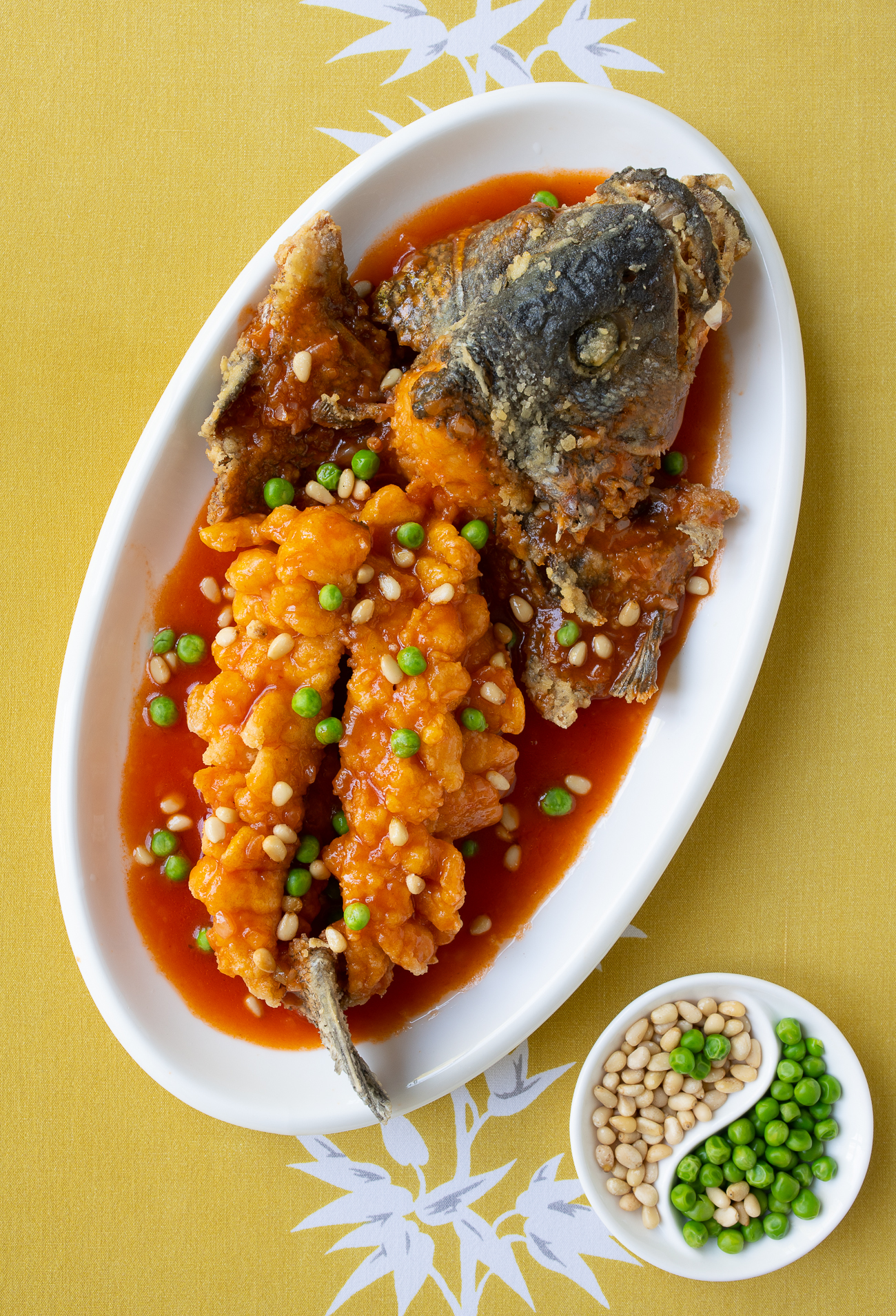
Sweet and Sour Squirrel Fish, or sōngshǔ yú (松鼠魚), is a legendary fish recipe from Jiangsu Province. While it’s a bit complicated, it can be done at home with patience and practice! We’ll show you how to make it from start to finish, with a full video showing the entire process (jump to the video).
While we’re using a whole fish (as is traditional) you can also try this recipe with fillets. With Chinese New Year coming up, now is the perfect time to impress family and friends with a show-stopping restaurant-quality dish!
What Is Squirrel Fish?
Squirrel fish is a Chinese whole fish preparation in which the fish is filleted, fried, and then smothered in a sweet and sour sauce.
While the fish is filleted, the two fillets remain attached at the tail and are fried in one piece. This creates the auspicious look of a whole fish with the convenience of a boneless eating experience!
What’s more, the fillets are cut into a cross-hatch pattern for plenty of crispy surface area and maximum sweet and sour sauce coverage. (A comparison to a bloomin’ onion from a certain unnamed chain of steakhouses is not unwarranted, both in concept and in the kitsch factor.)
Ultimately, it’s dramatic, yet playful. It was a favorite on Qing Dynasty emperors’ tables, and for good reason. It’s an intricate dish that requires skill to make.
The recipe is an example of Huaiyang cuisine, one of China’s four major culinary traditions (the others are Chuan/Sichuan Cuisine, Lu/Shandong Cuisine and Yue/Cantonese cuisine). There is now also a list of the eight great cuisines of China, which we’re currently writing a post about. Stay tuned!
Why Is It Called Squirrel Fish?
By now you’re thinking—yes, but what’s so squirrel-y about it?
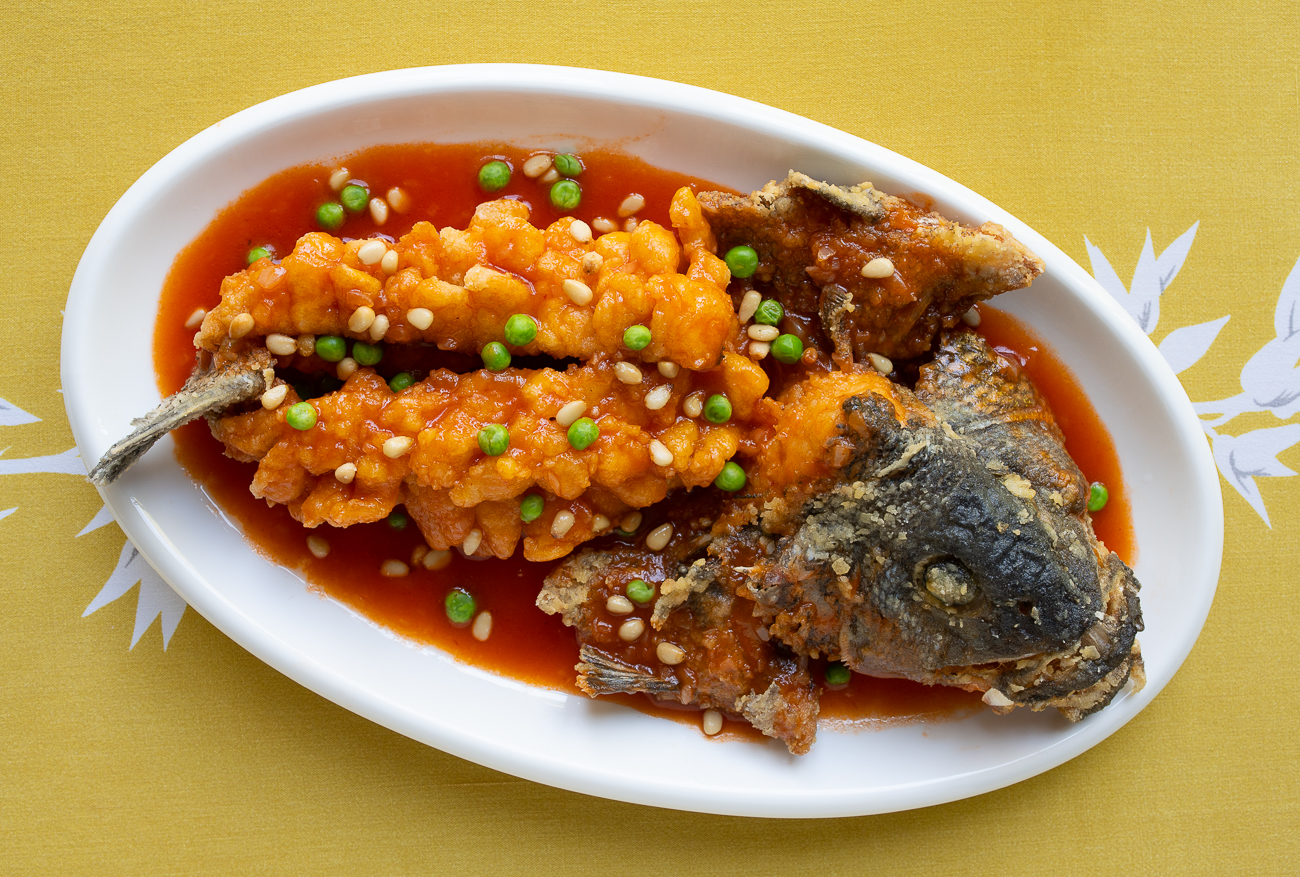
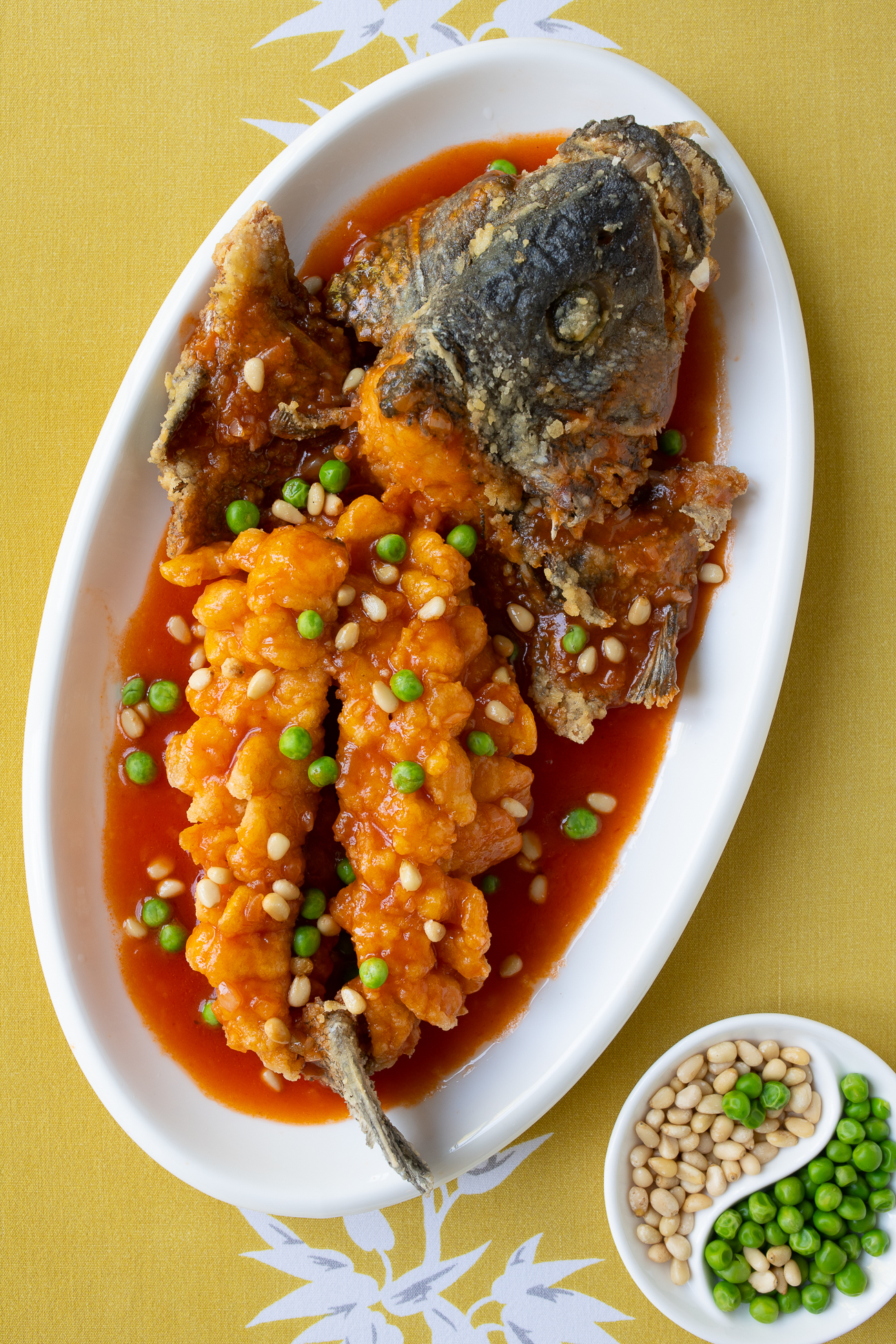
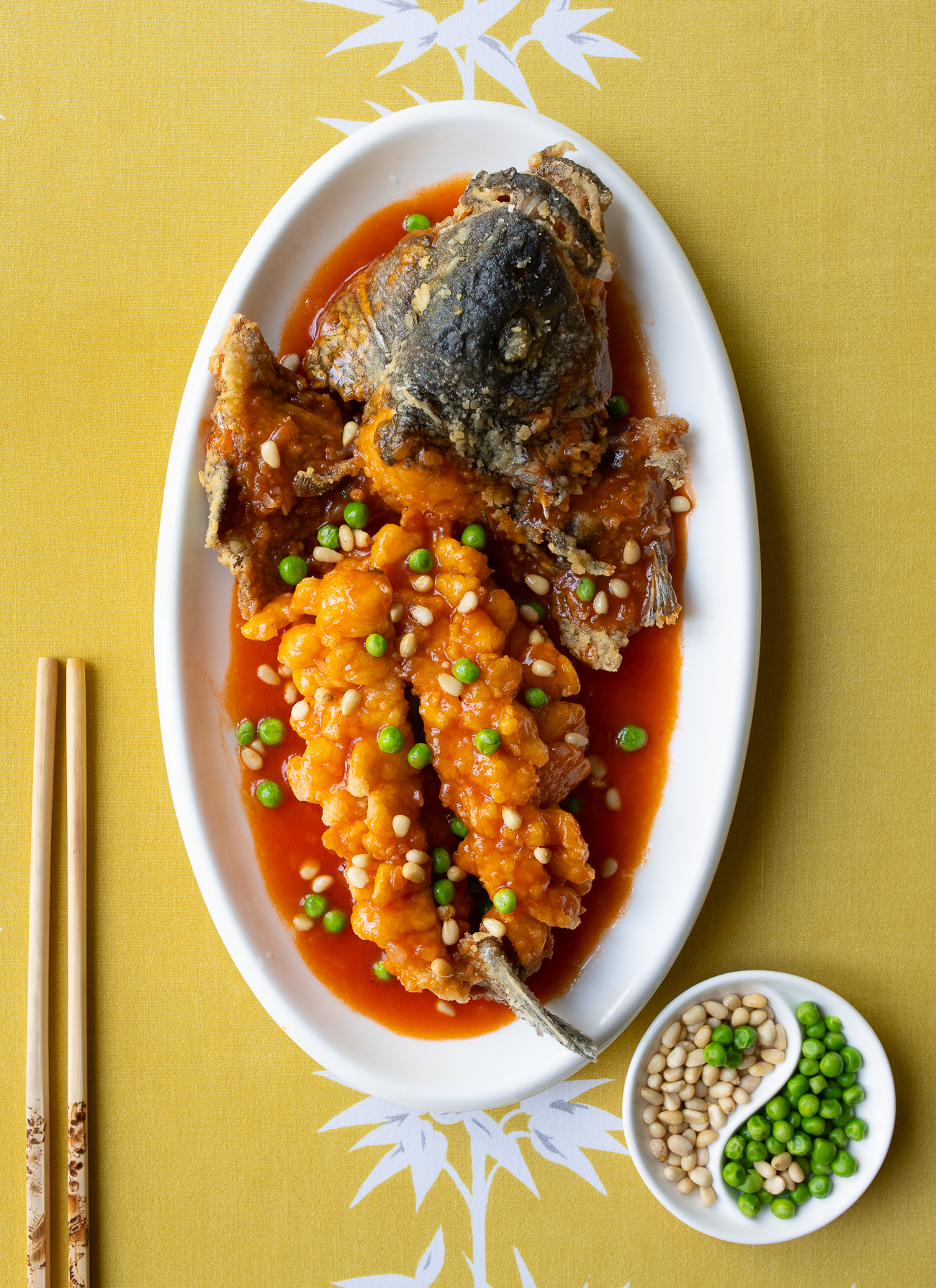
The most common explanation seems to be that the shape of the fish, with its blown out sides and jaunty upright tail–set during the frying process–resembles a squirrel, or a squirrel’s tail.
Some restaurant chefs garnish the fish to make the visual comparison more obvious, arranging the fish so the front fins look like little squirrel ears.
A sprinkling of pine nuts over the top is also common (they bring to mind squirrels frolicking among the pinecones…right?).
Others say the name comes from the squeaking sound the fish makes while frying (though we never heard any extraordinary sounds from ours).
Whatever the explanation, the tender bites of crispy, flaky fish in this red sweet and sour sauce is totally addictive. (Maybe it’s the color?! There are red squirrels, right? Okay, that’s our last guess.)
What Type of Fish to Use
In China, the traditional fish of choice is Chinese lake perch, also known as Mandarin fish (guì yú – 桂鱼).but inexpensive grass carp (cǎo yú – 草鱼) is sometimes used, too.
Here in North America, sea bass or freshwater bass are good options, but we’ve also had good results with branzino (Mediterranean sea bass), which is delicious and widely available.
The perch is ideal, because it’s plump with few bones, making it easier to cook into the ornate shape.
While this recipe is more challenging than most, we had to instruct you in the way it was intended—as a show stopping whole fish dish.
In fact—we had to make the dish twice just to complete this post—once to do the step-by-step fish cutting photos, and again to film a detailed video showing you the entire process. (Note: both times, we used a sea bass!)
It’s tricky to pull off, but all you kitchen thrillseekers out there in need of a litmus test for your mastery of Chinese cooking technique? This one’s for you.

Not Keen on whole fish?
If you’re not confident using a whole fish, you can use skin-on fillets (2 large-sized fillets or 3-4 small fillets) to make Squirrel Fish. Just follow the cross-hatching instructions, dredge and fry the fish, and prepare the sauce as described.
Recipe Instructions
Make the Sauce Mixtures:
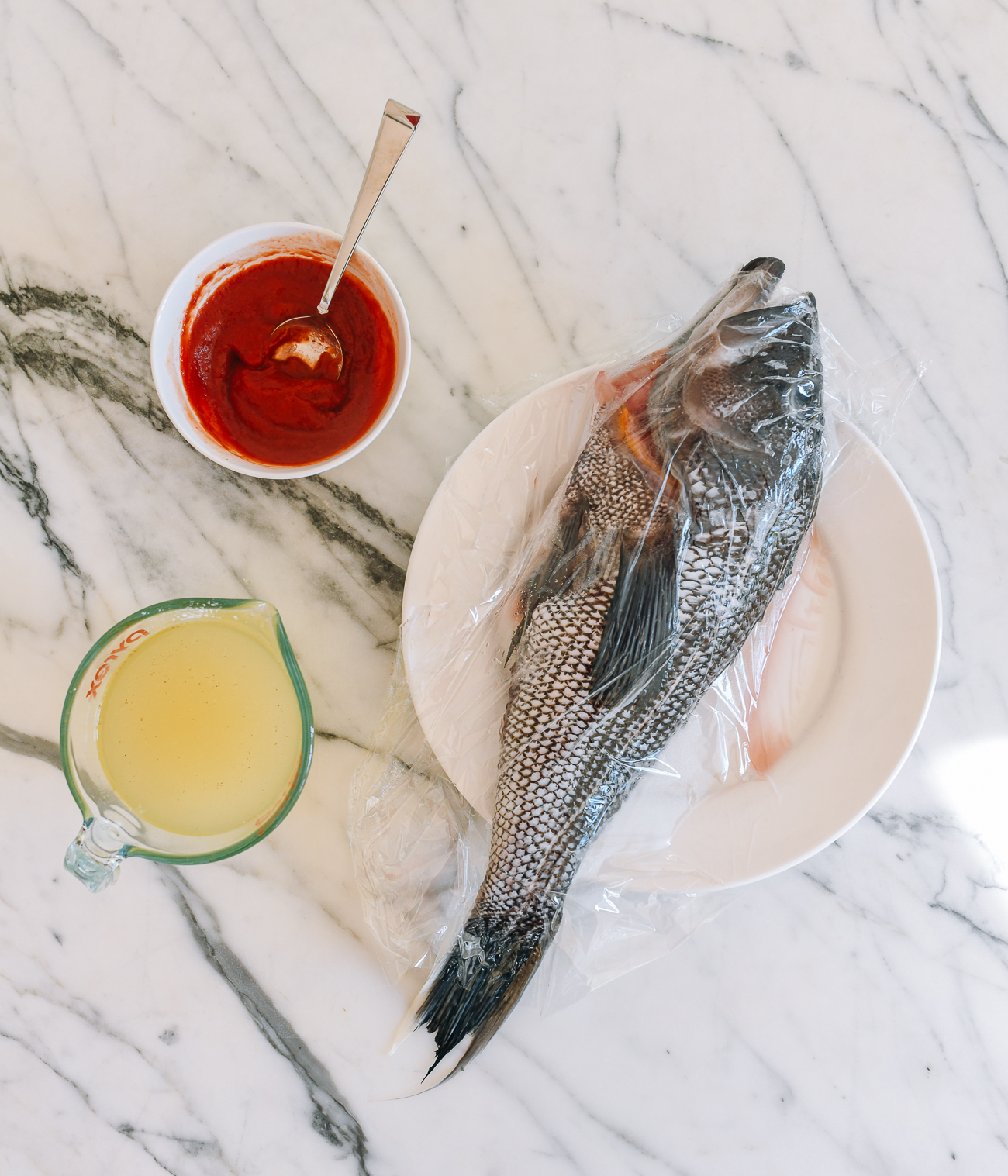
Make sure you start with a scaled, cleaned, and gutted fish. Your local fishmonger can do this for you.
Make the vinegar mixture: In a medium bowl, dissolve the sugar in ½ cup of hot water, and mix in the cornstarch, white vinegar, pineapple juice, salt, and white pepper.
Make the tomato mixture: In a separate small bowl, mix the ketchup, tomato paste, and 1½ tablespoons hot water until smooth.
Fillet the Fish & Make Crosshatch Pattern:
Now, to the fish! You’ll fillet each side of the fish, taking care to keep the two fillets attached at the tail.
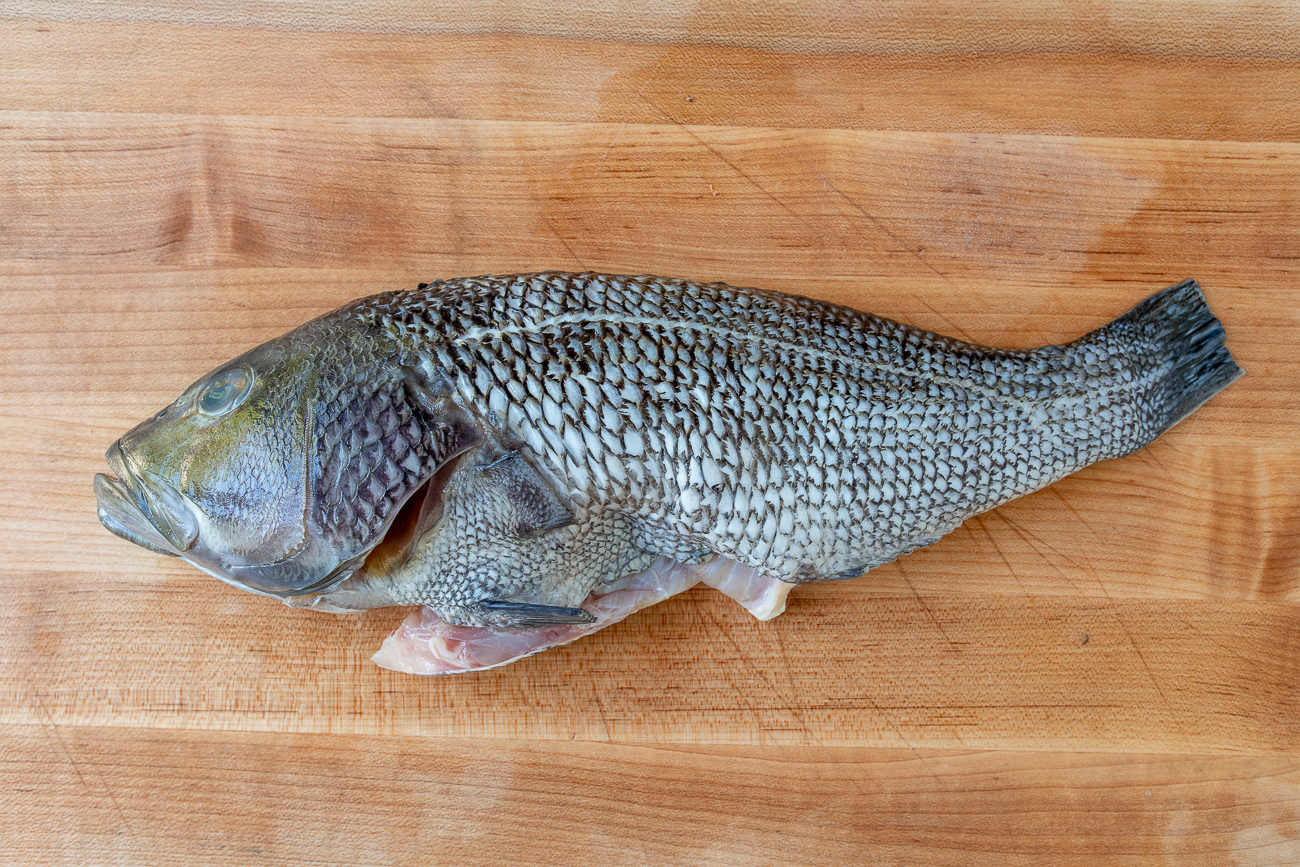
If you’ve never filleted a fish before, here’s a beginner method to use. First, place your knife diagonally across the fish, just behind the head, collar and pectoral fins. Slice into the fish until you reach the backbone.
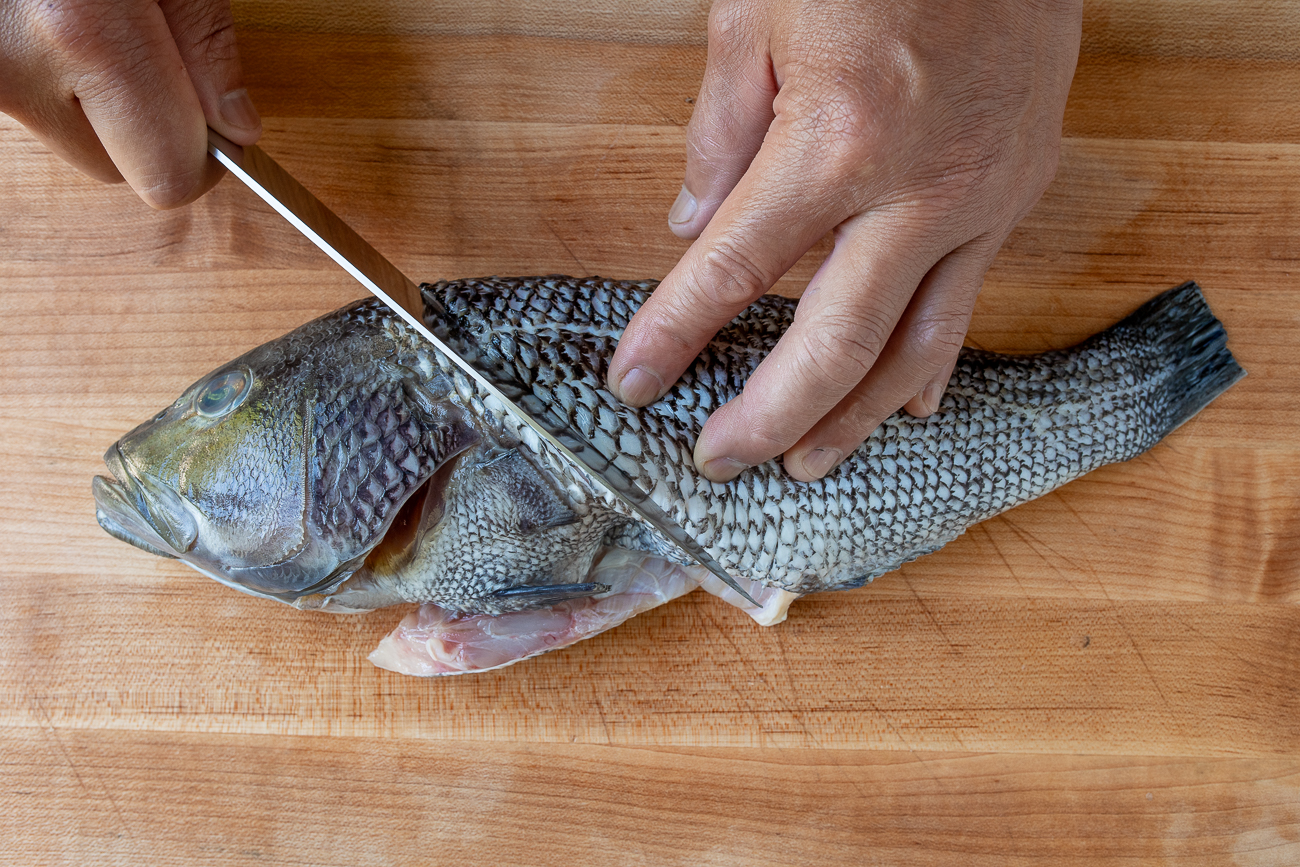
Turn the fish so the belly is towards you. Place your knife at the head end, just above the backbone. Angle your knife blade slightly up (away from the backbone). Run the knife along it, pulling the meat up as you cut between the fillet and the bone.
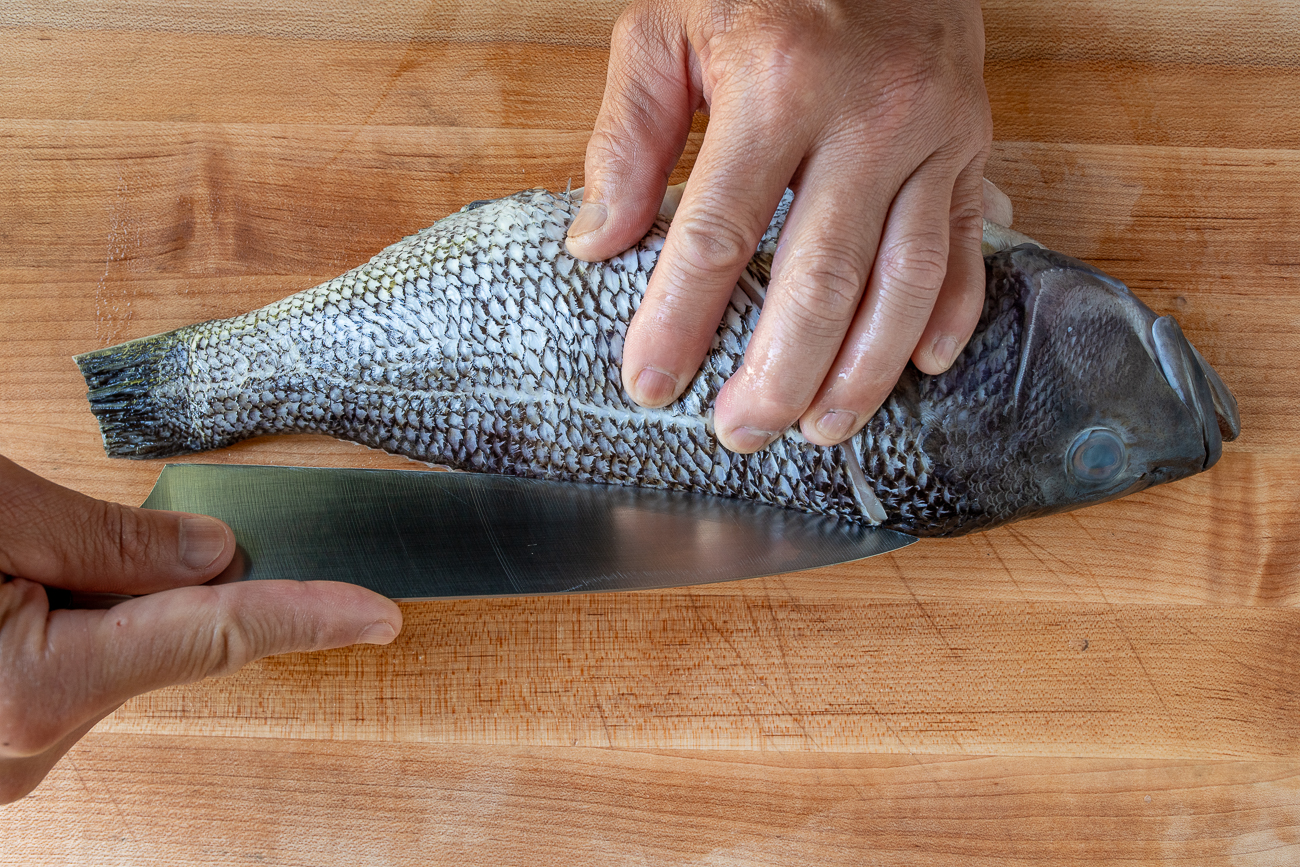
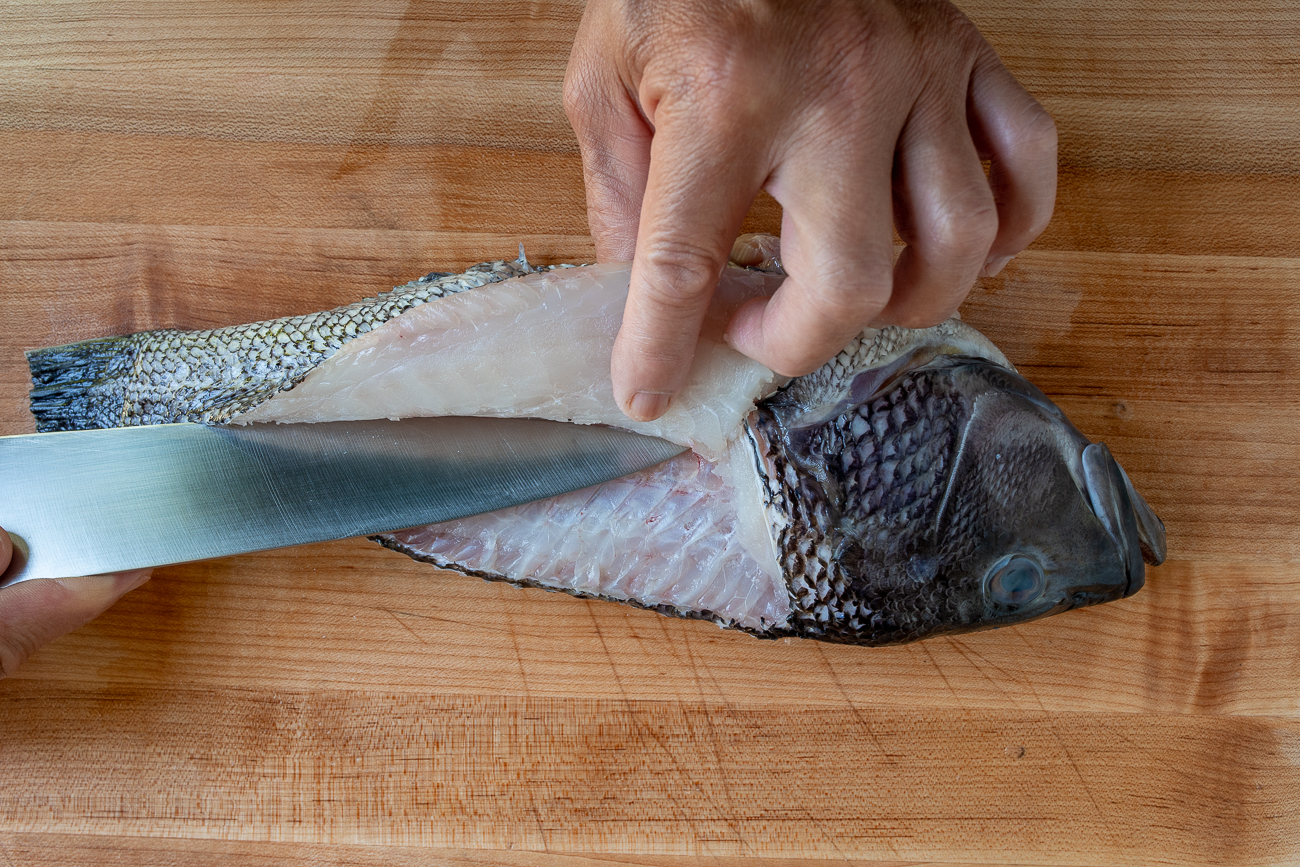
Then with your knife perpendicular to the fish, finish slicing the fillet from head to tail, using the backbone as a guide and stopping about 1-inch short of the tail.
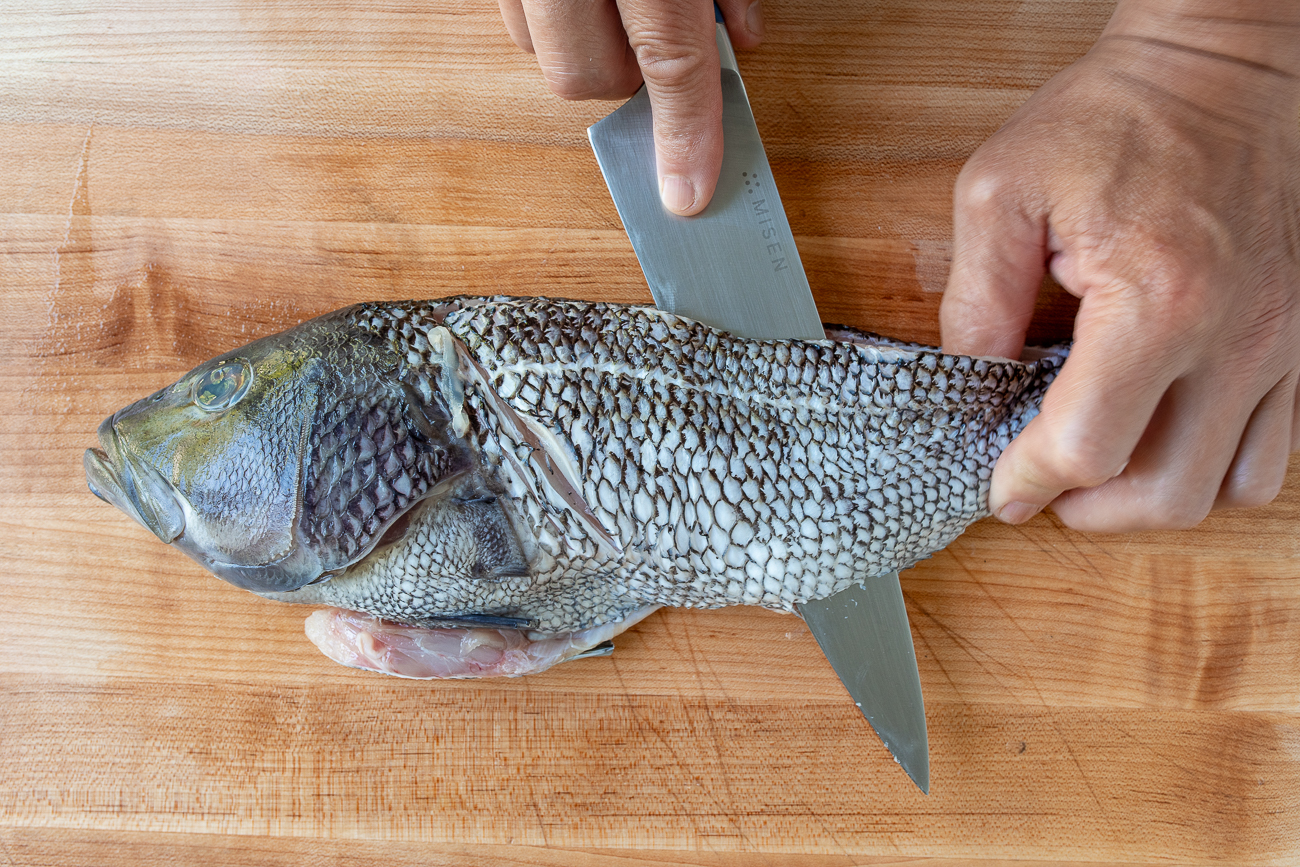
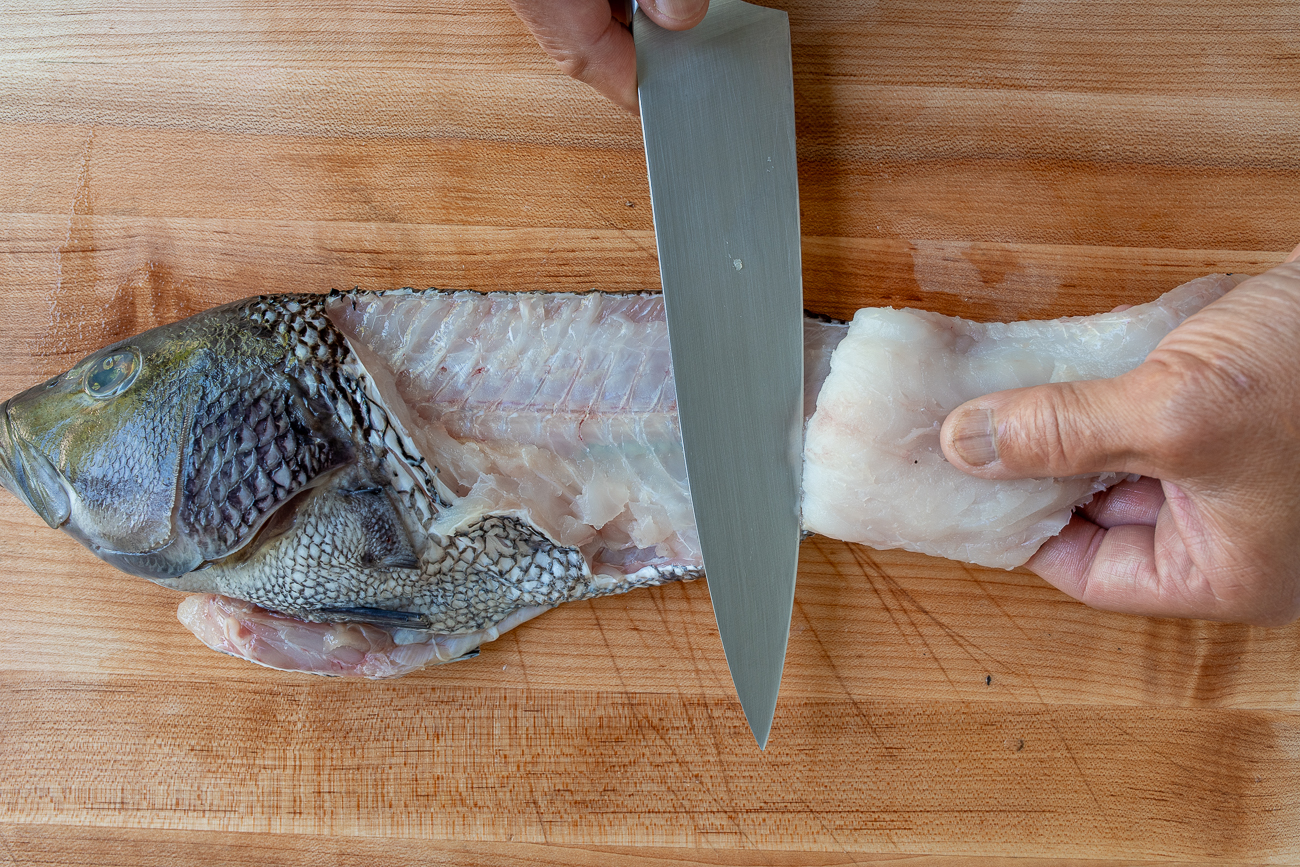
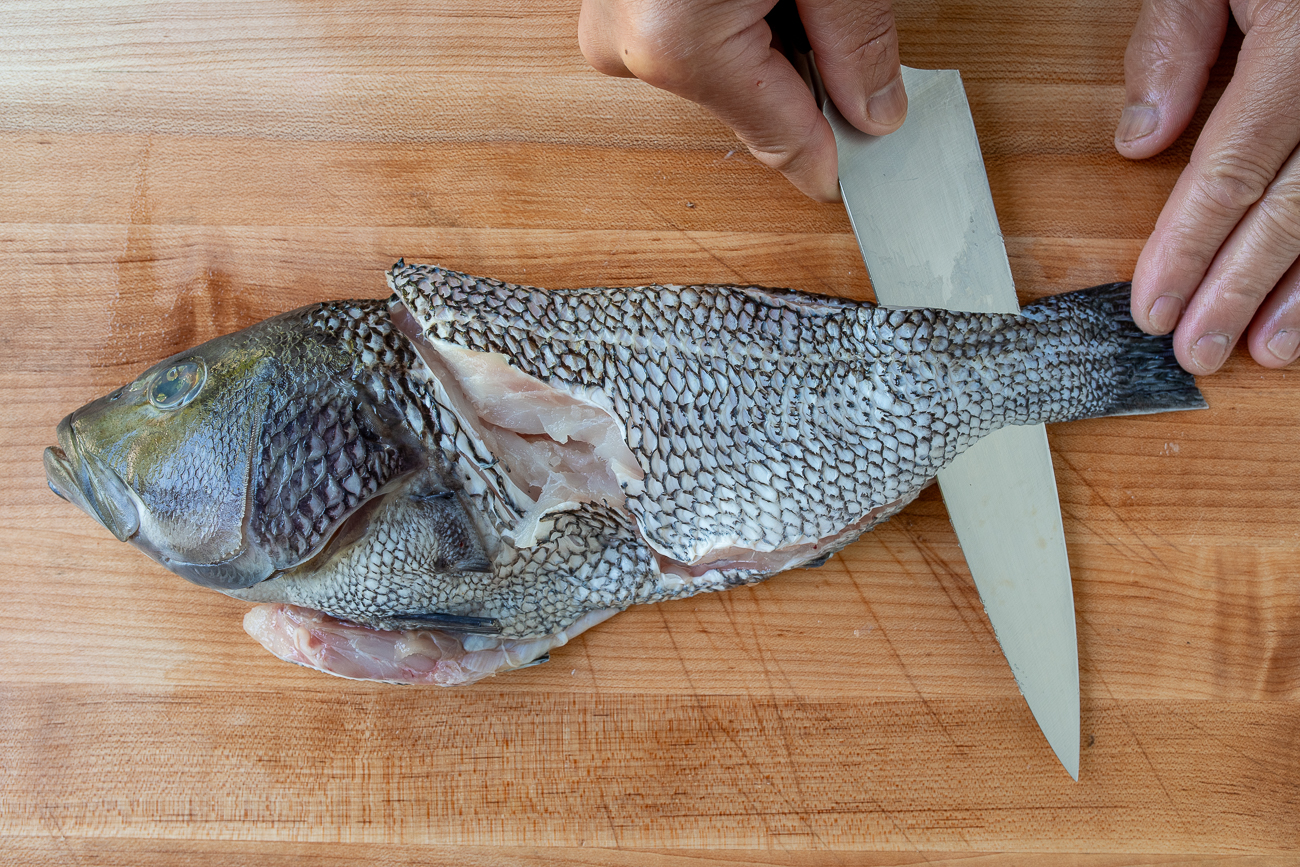
Flip the fish over and do the same on the other side.
Next, cut the spine of the fish at the base of the tail.
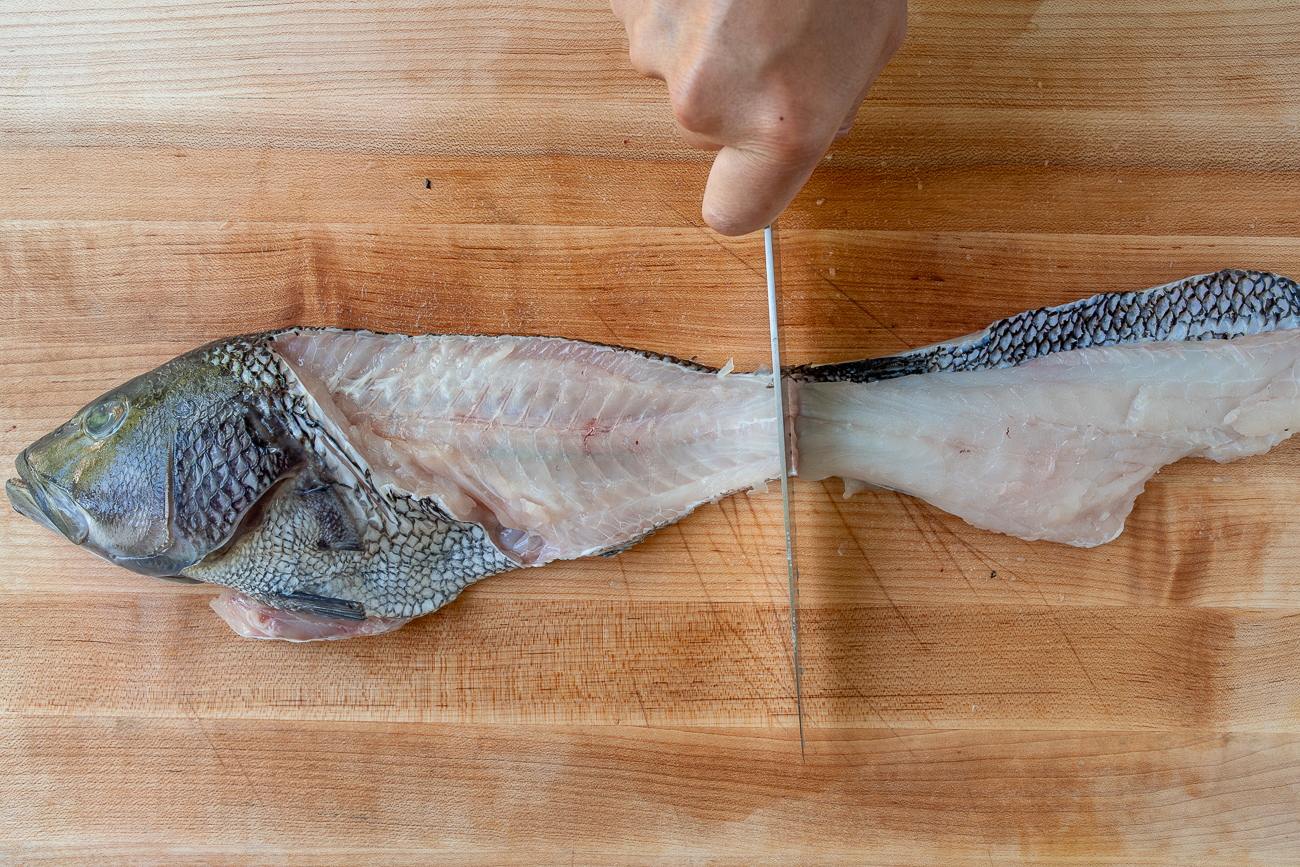
This will separate the tail and the two attached fillets from the rest of the fish.
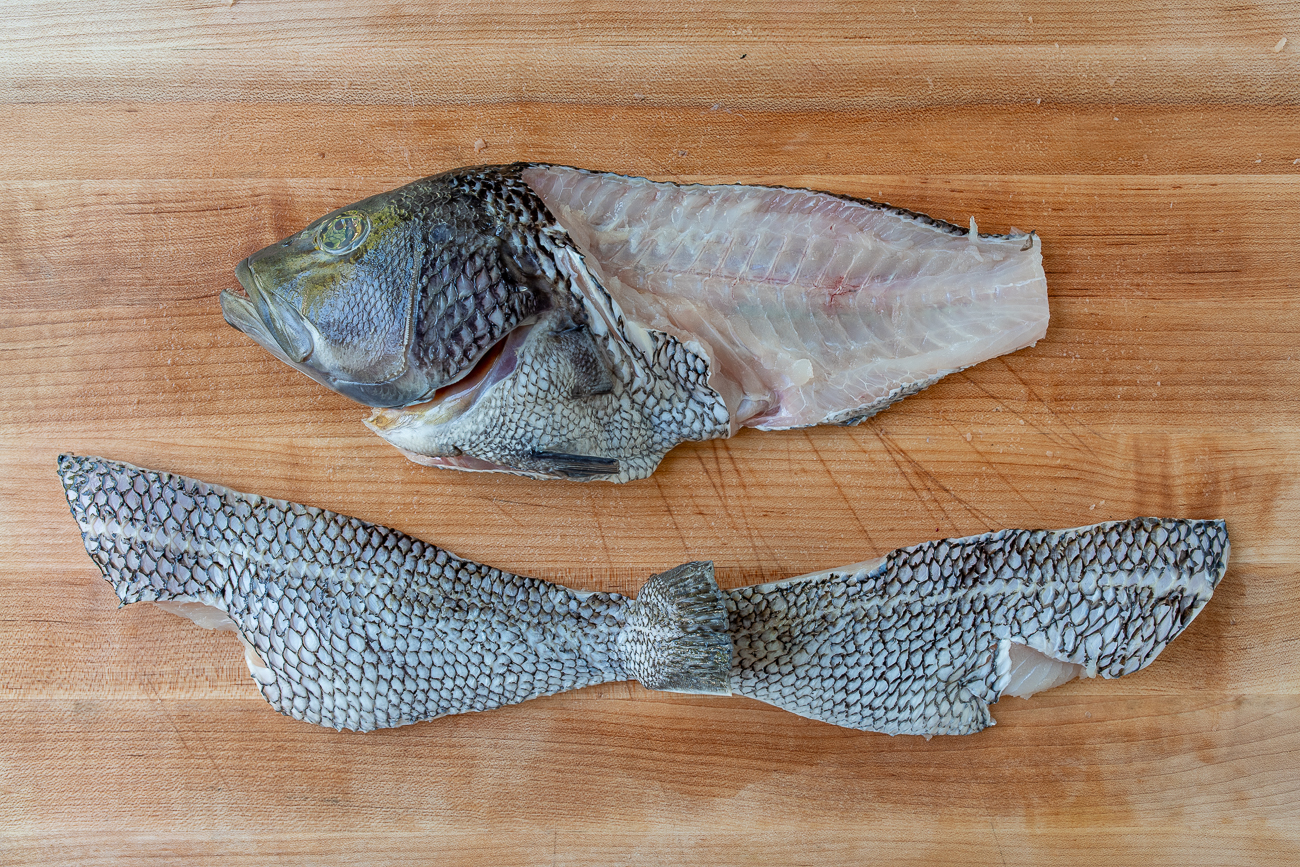
Using the heel of your knife, make a cut through the backbone just behind the head and the collar. This will separate the head from the spine of the fish.
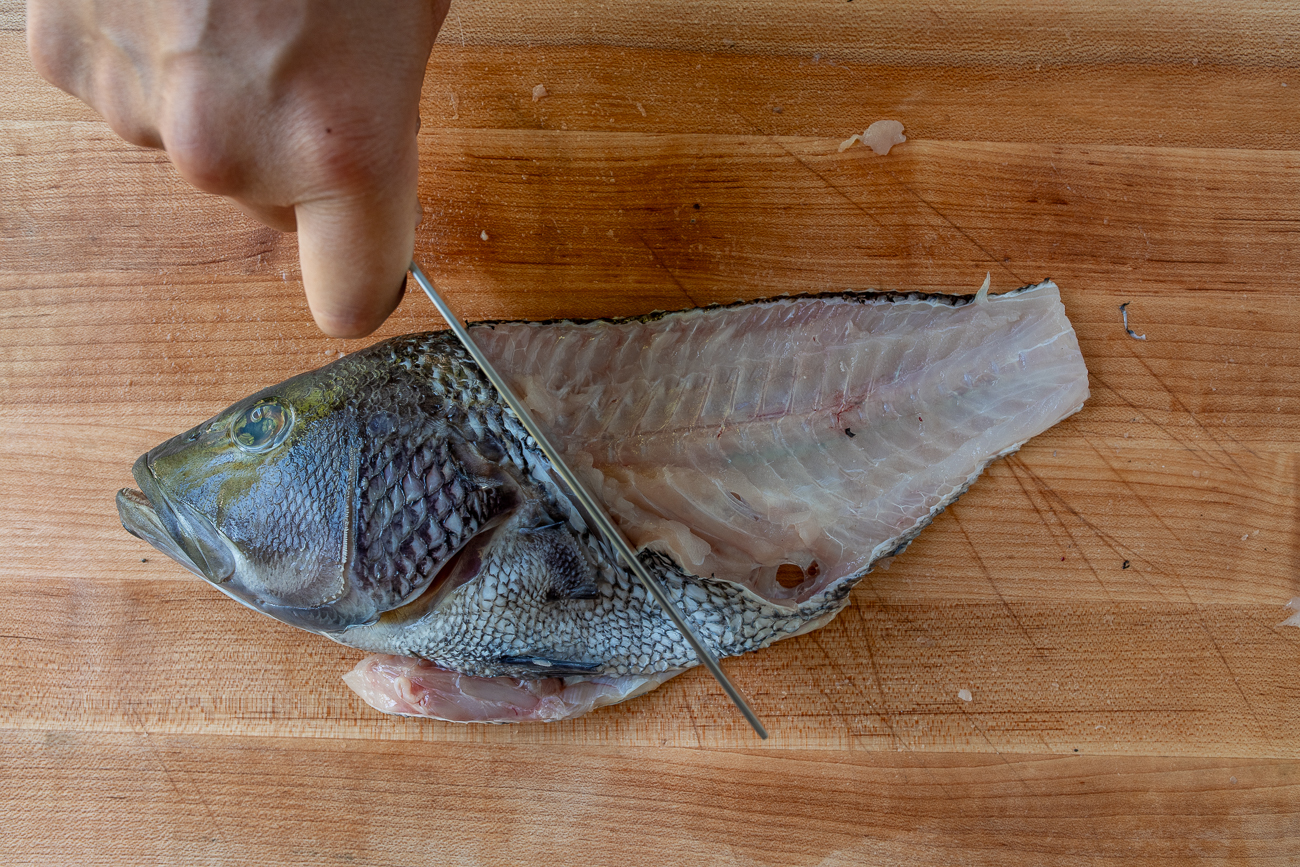
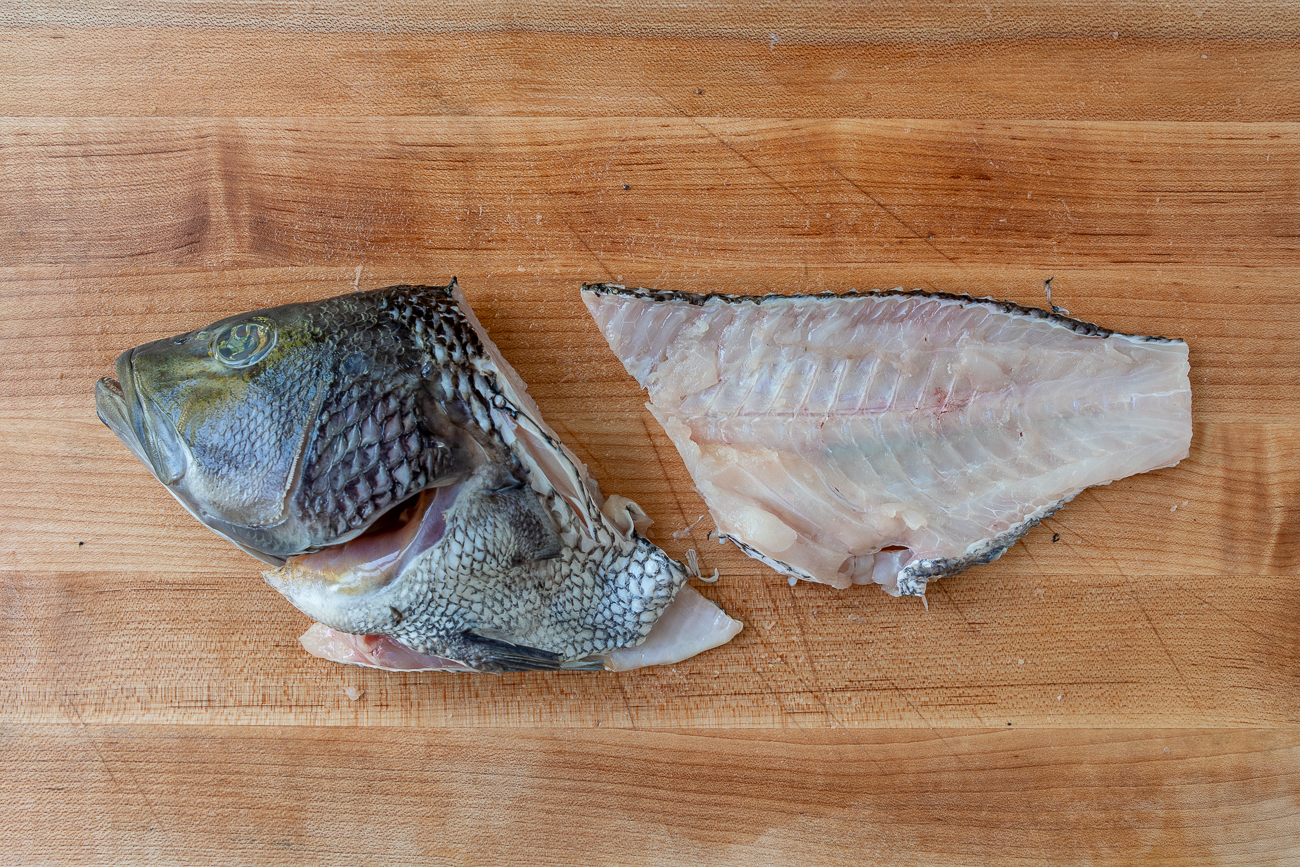
The head should be able to sit on a flat surface with the mouth pointed up at an angle and each side of the pelvic fin portion of the fish flared to each side, supporting the head.
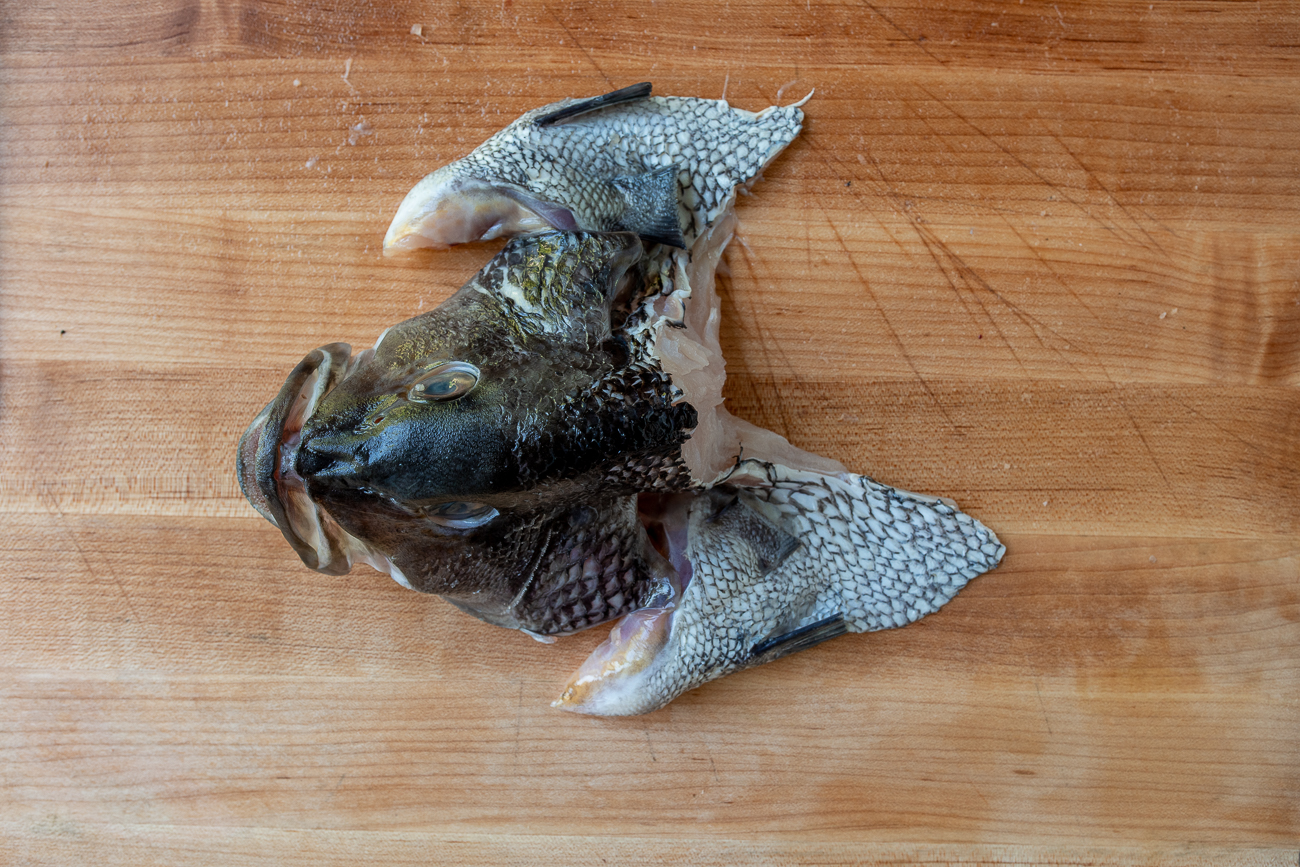
The meat on the pelvic fin area can be a delicacy or fishy depending on the fish, so this is primarily for presentation. You may need to use your cleaver to flatten it slightly, so it sits at the correct angle. Set aside.
Ok, back to the fillets. With your knife at a slight angle, carefully score the fillets lengthwise—deep enough to reach the skin beneath without actually cutting through the skin. (Slicing the fish at an angle makes each segment longer with more surface area, and also helps prevent the knife from cutting through the skin.)
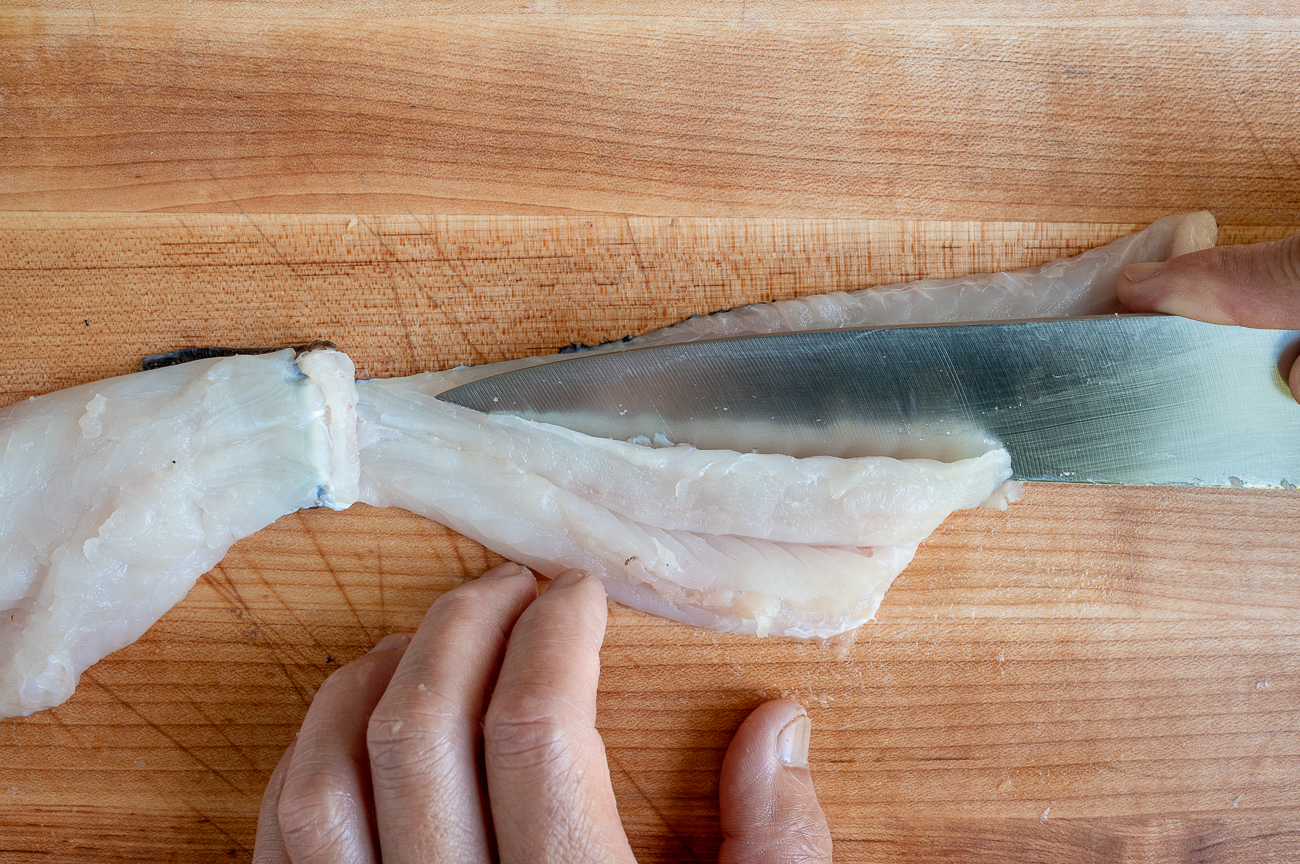
Space the cuts ½ inch apart (you should be able to make 3-4 cuts easily, depending on how fat your fish is). Next, score the fish crosswise (again, at an angle), cutting down and away from the tail.
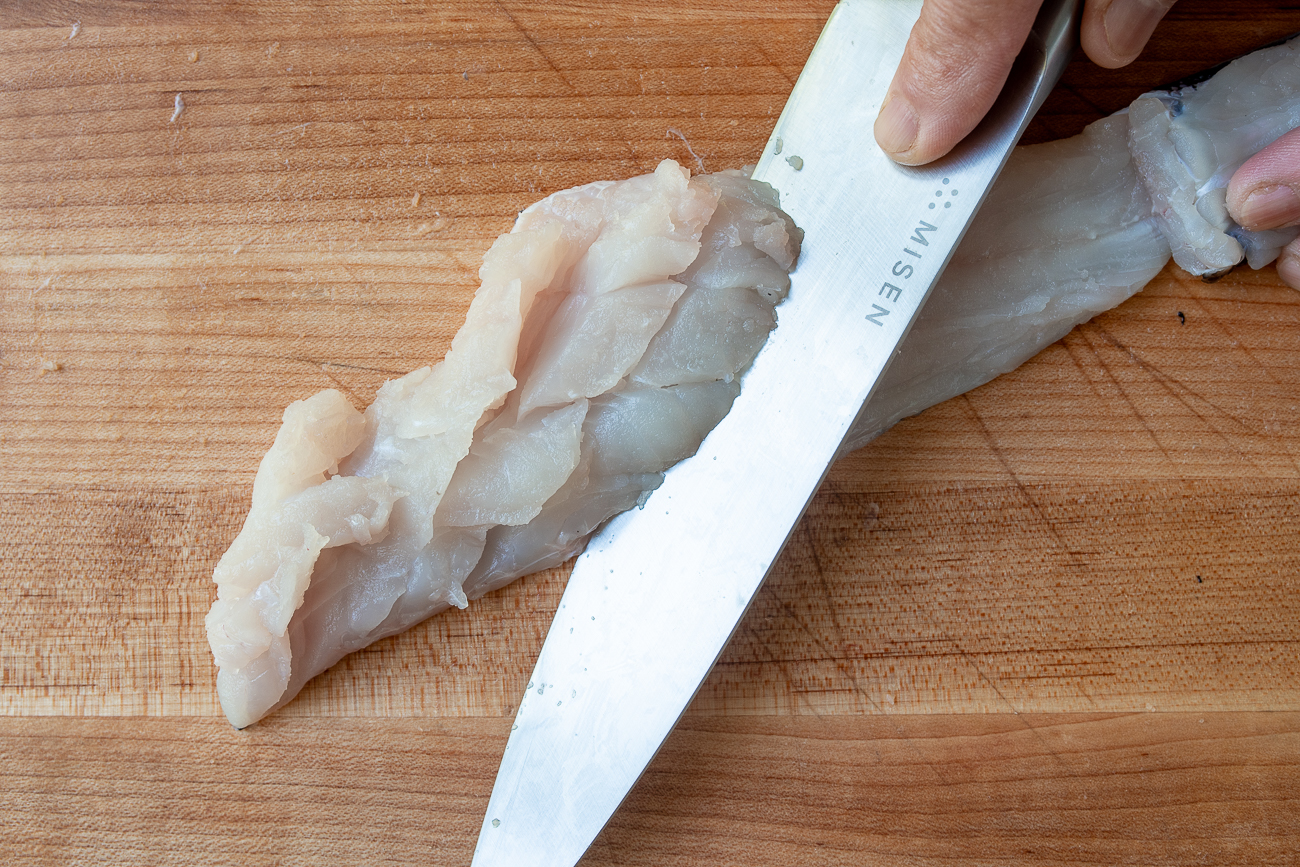
Once again, make the cuts deep enough to reach the skin without cutting through it. This will create a crosshatch pattern. Each fillet segment should be roughly a ½-inch square.
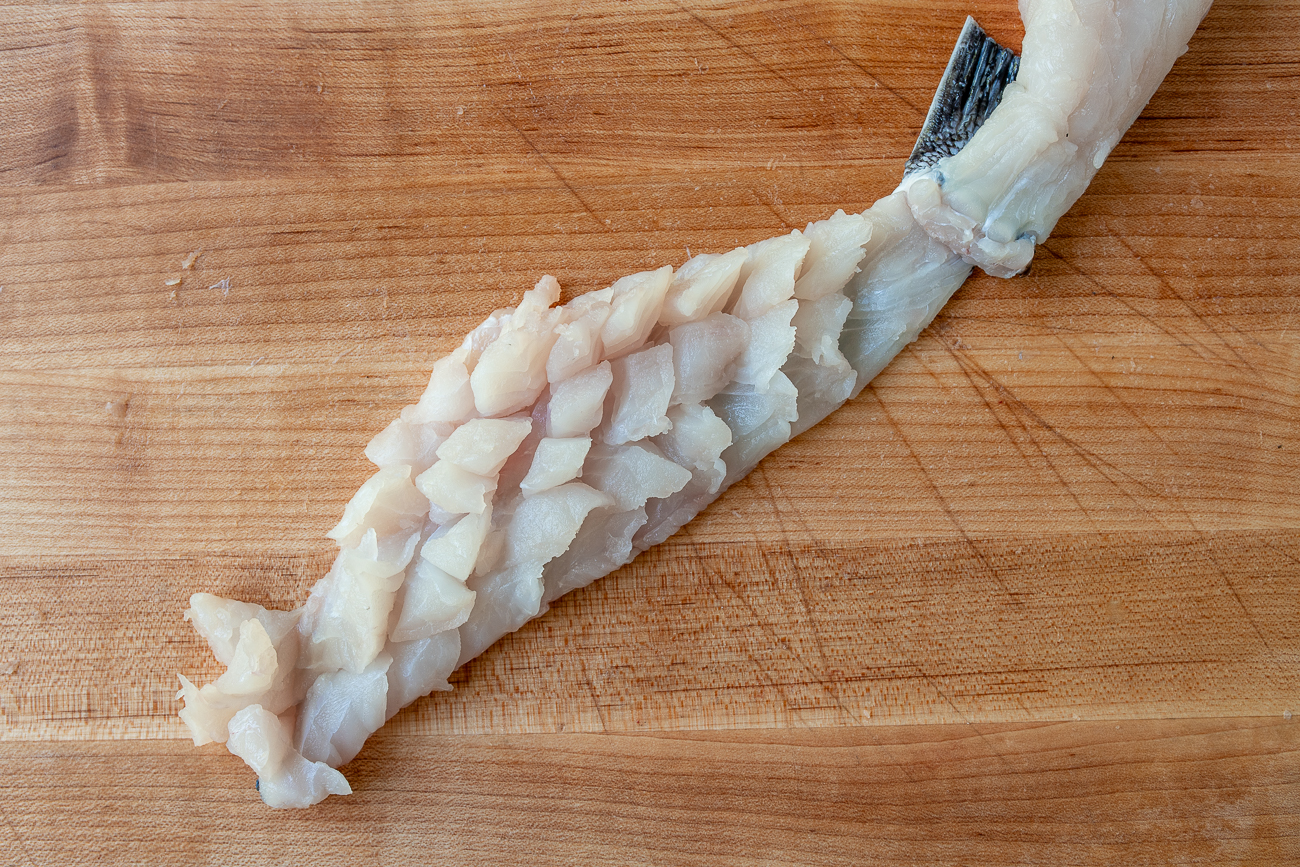
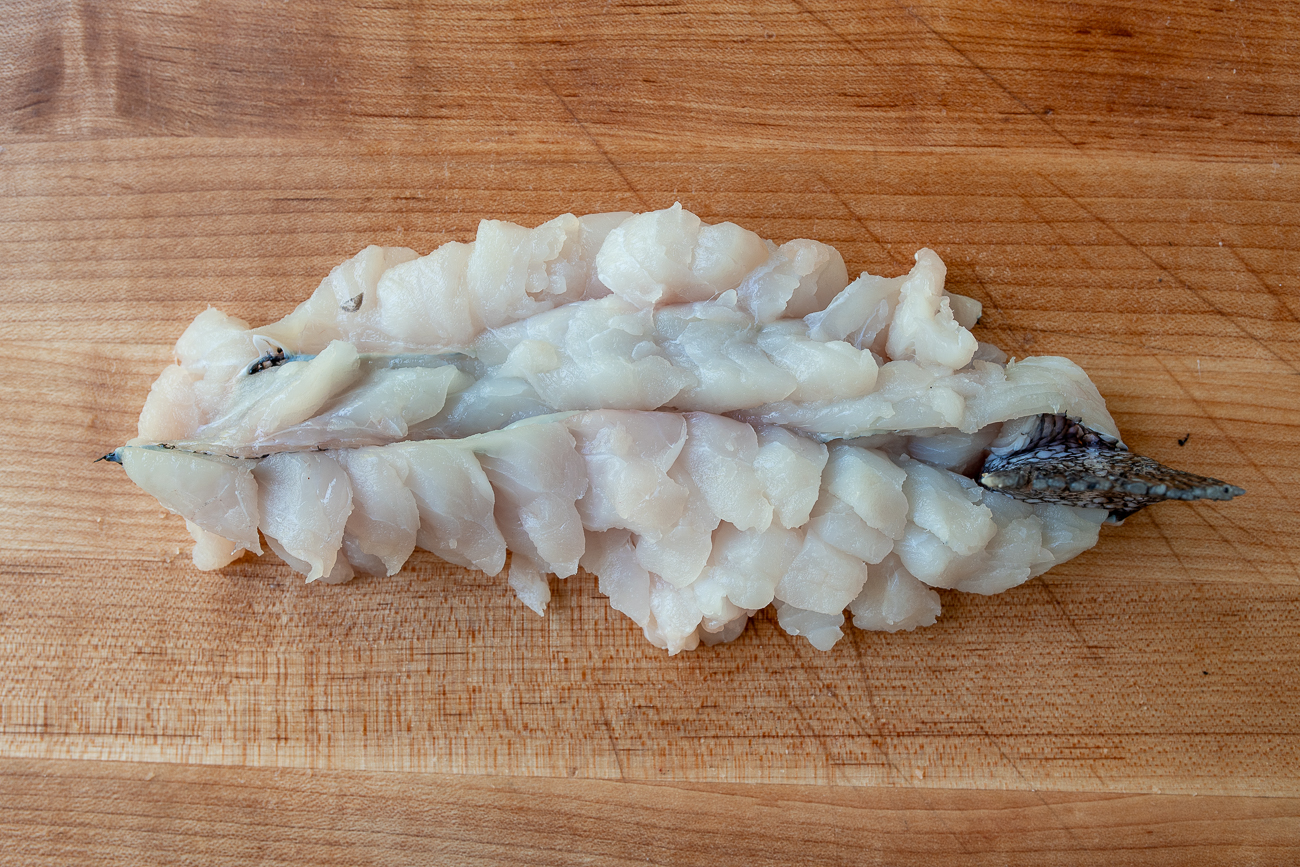
Dip the fish into an ice bath to rinse off any debris from processing and to tighten up the meat. Pat thoroughly dry with a paper towel. You should have two pieces: the head with the pectoral fin pieces attached and one large tail piece with the two cross-hatched fillets attached to it.
Dredge the Fish:
In a large bowl, combine the salt, white pepper, clear rice wine, sesame oil, and egg yolk. Coat the fish–the head and the fillets with the tail–in the mixture, ensuring all the nooks and crannies are covered.
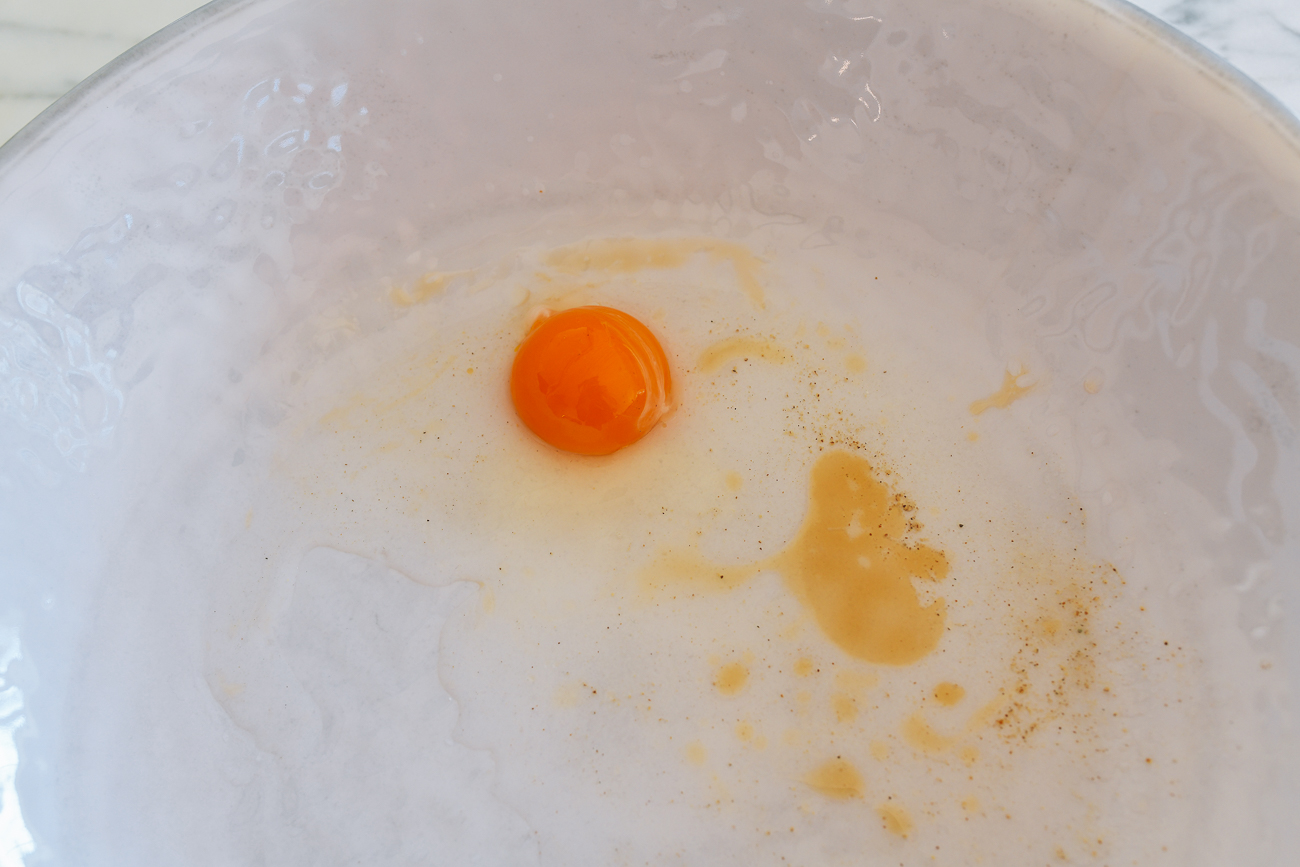
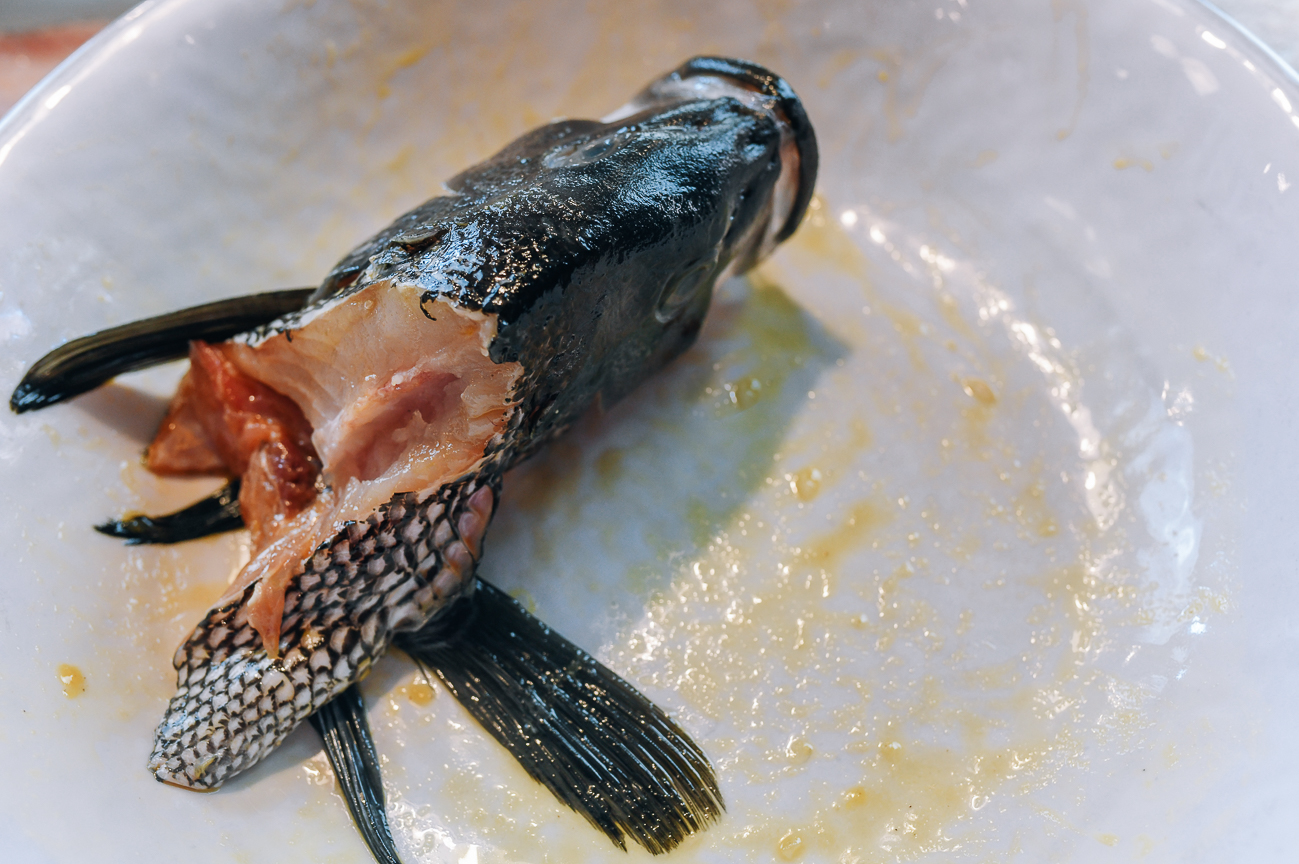
Pour the cornstarch onto a small sheet pan and dust the fish with it. Thoroughly coat all the nooks and crannies, and shake off any excess.
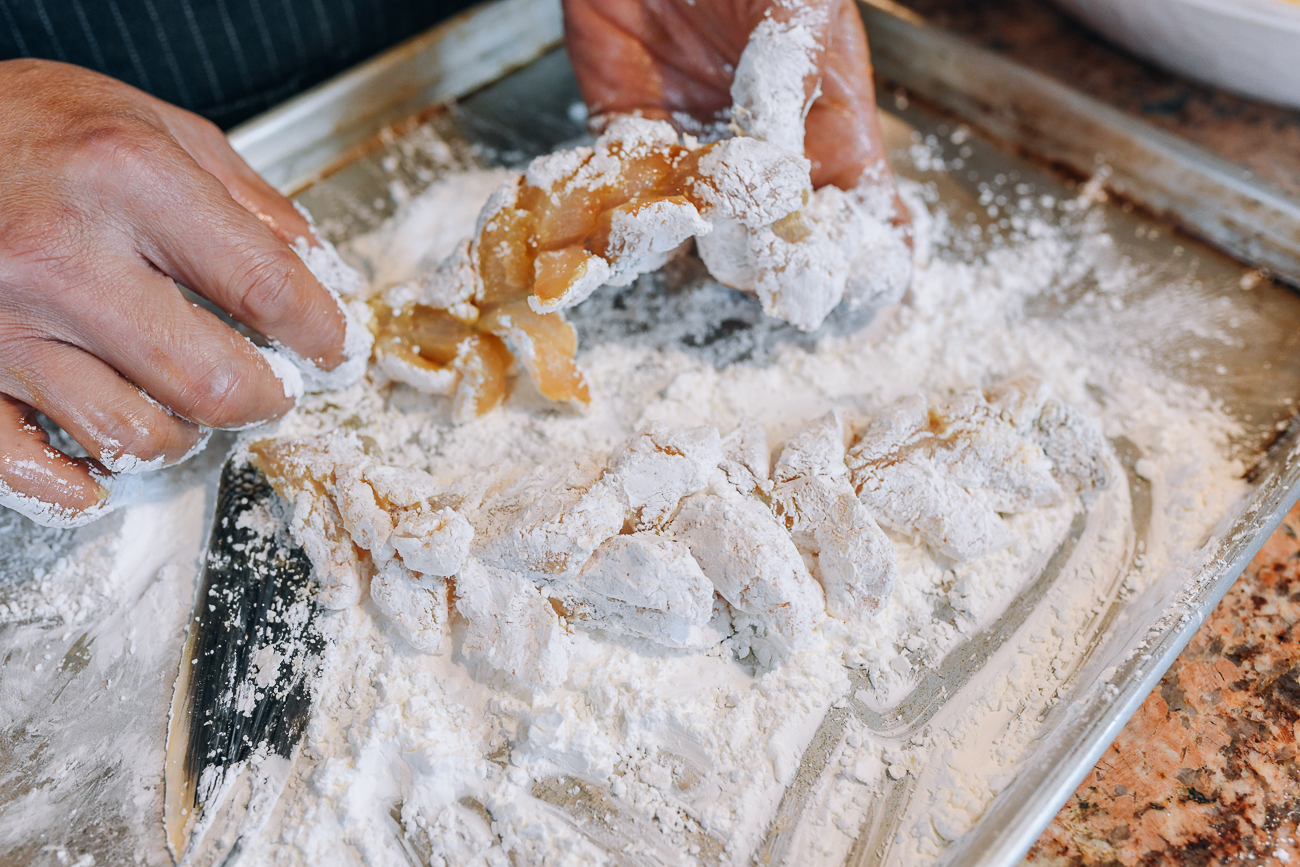
You may have to repeat the process for full coverage.
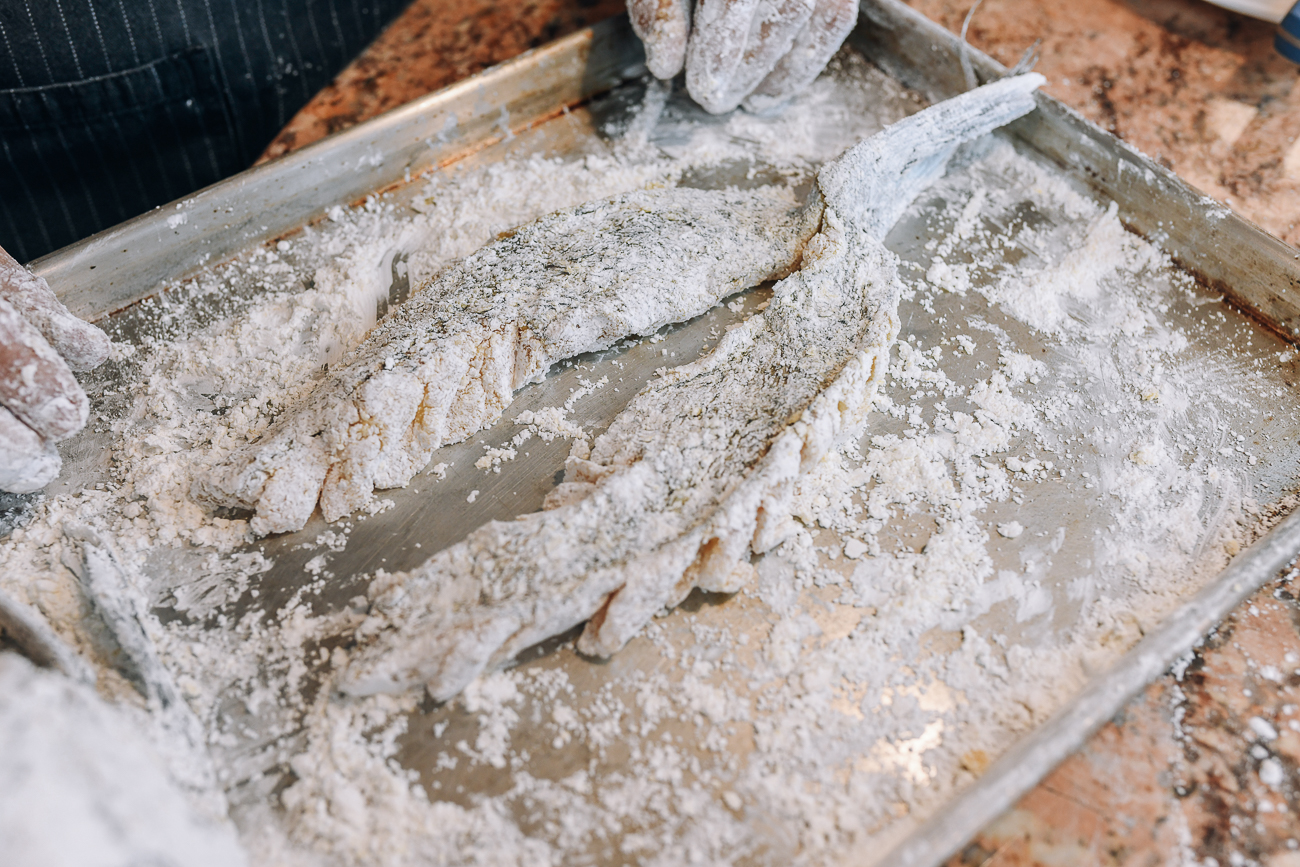
If desired, you can wedge a half a toothpick between the top and bottom of the fish mouth so it stays open during the frying process. This creates a dramatic traditional presentation for the final dish.
Fry the Fish:
Heat 6 cups of oil in a wok to 425°F.
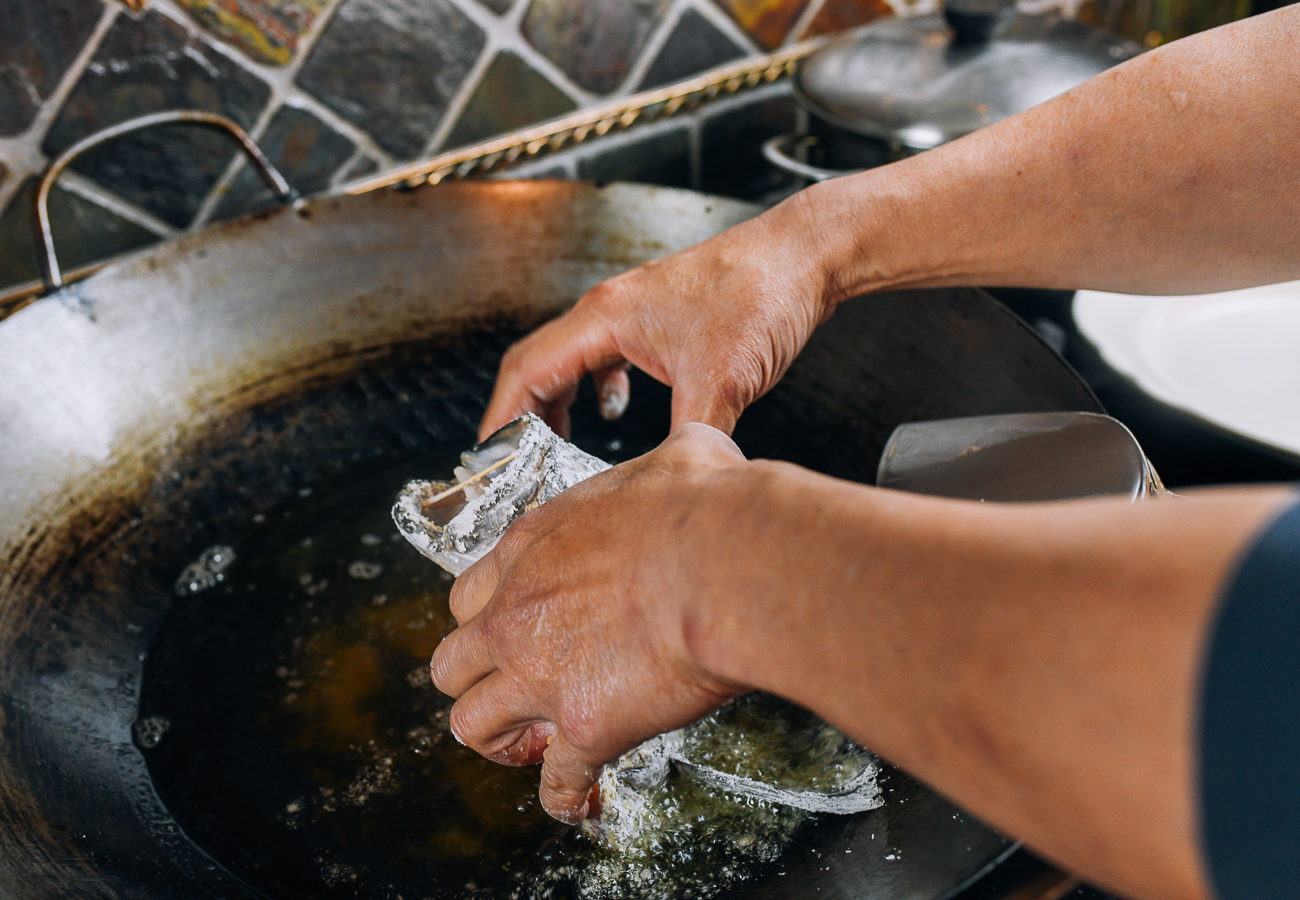
Now you’re ready to fry the big piece of fish with the fillets. First, use one hand to grab the fish by the tail. With your other hand, use a pair of tongs to grab the opposite end. Clamp the two fillets together so the skin is facing up, and the cross-hatched pieces curl and flare outward.
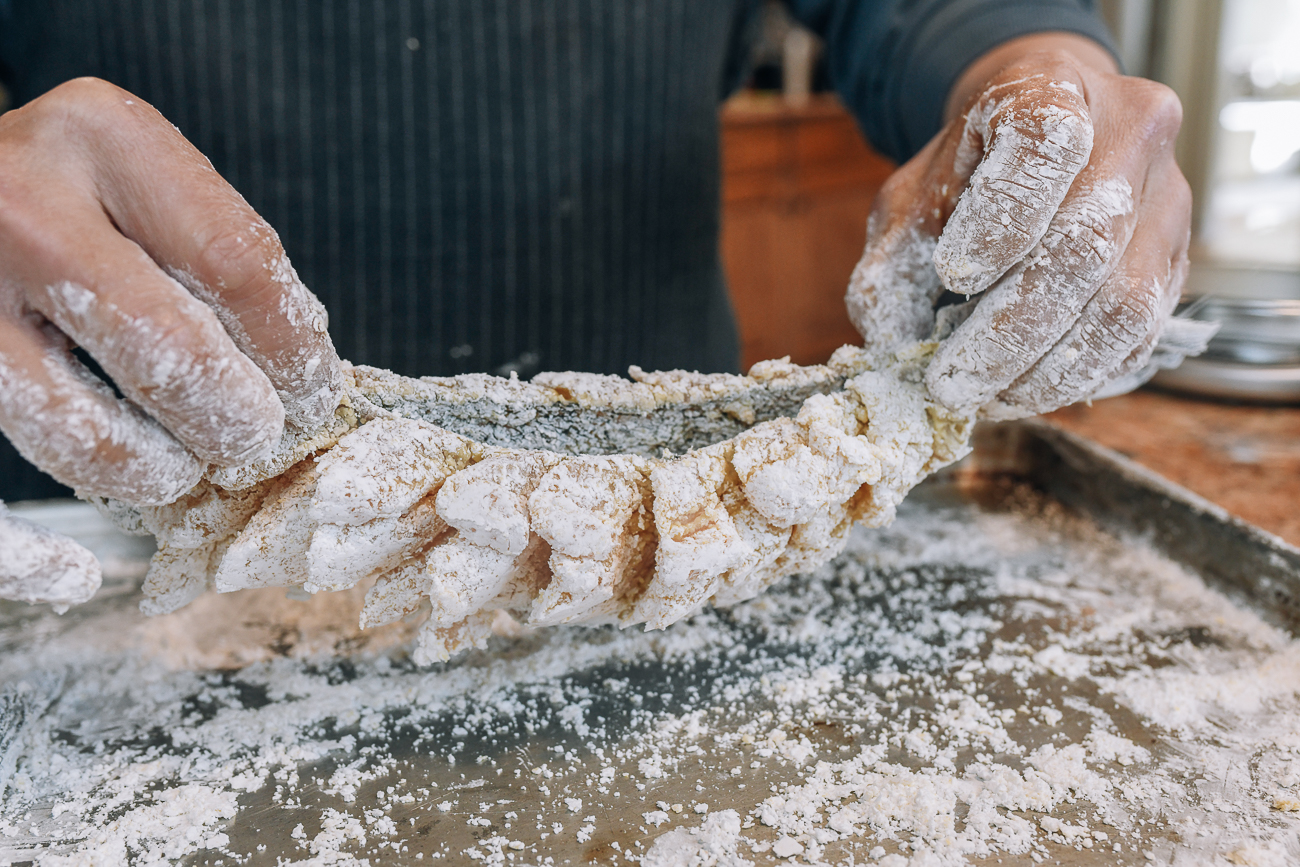
Lower the fish into the oil carefully for 10-15 seconds to set the shape, keeping both ends of the fish out of the oil. This not only allows you to hold onto either end safely, it gives the fish a slight curled shape. (If preferred, use 2 pairs of tongs, though it may be harder to maintain a good grip on the fish.)
When the cornstarch coating is fried to the point that the two fillets are grafted together, release the fish gently into the oil, and let it fry for 5 minutes. The temperature will have lowered when the fish was added to the oil—keep it at 350°F/175°C.
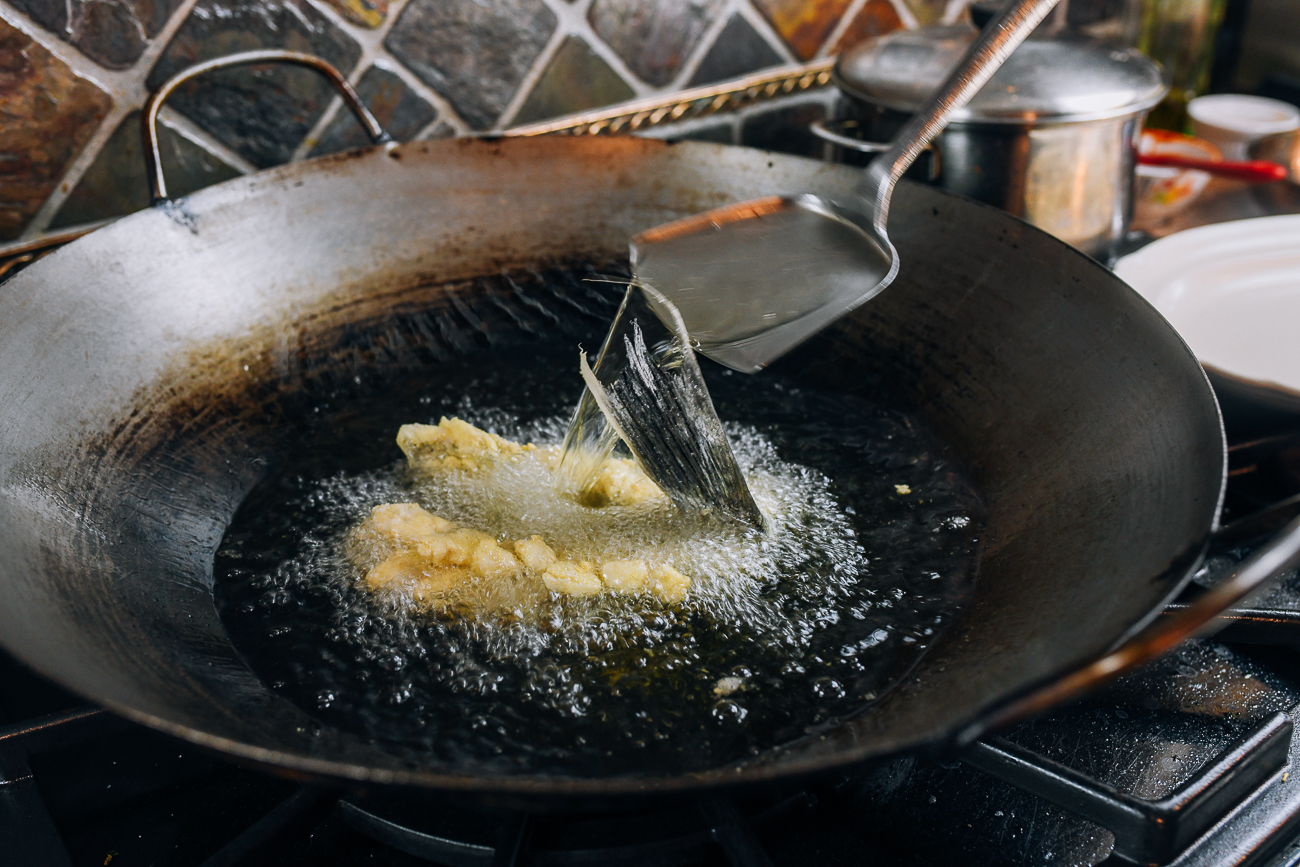
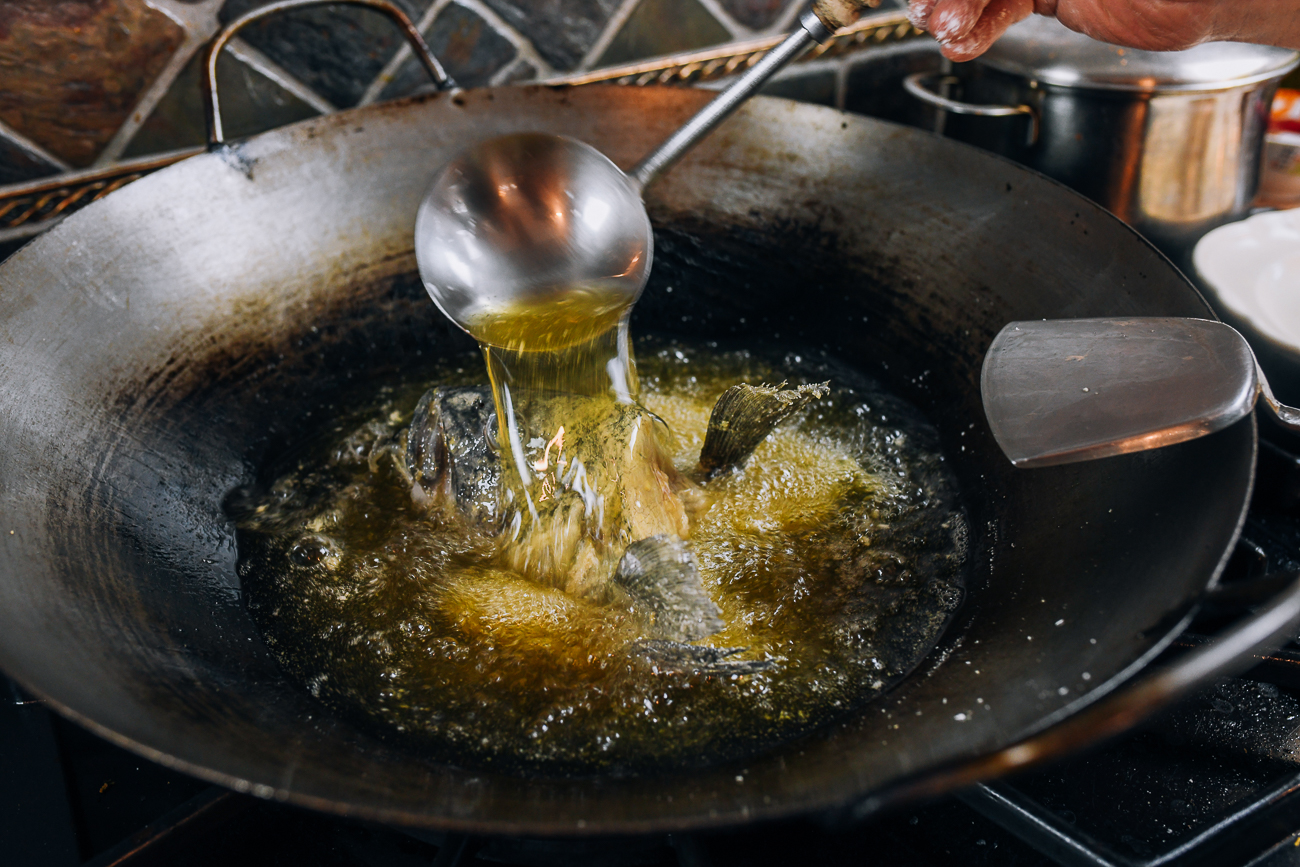
It should keep its shape (the fillets shouldn’t float apart in the oil). Do not move or flip the fish. Just use a wok spatula or ladle to carefully spoon the hot oil over the top of the fish for even frying.
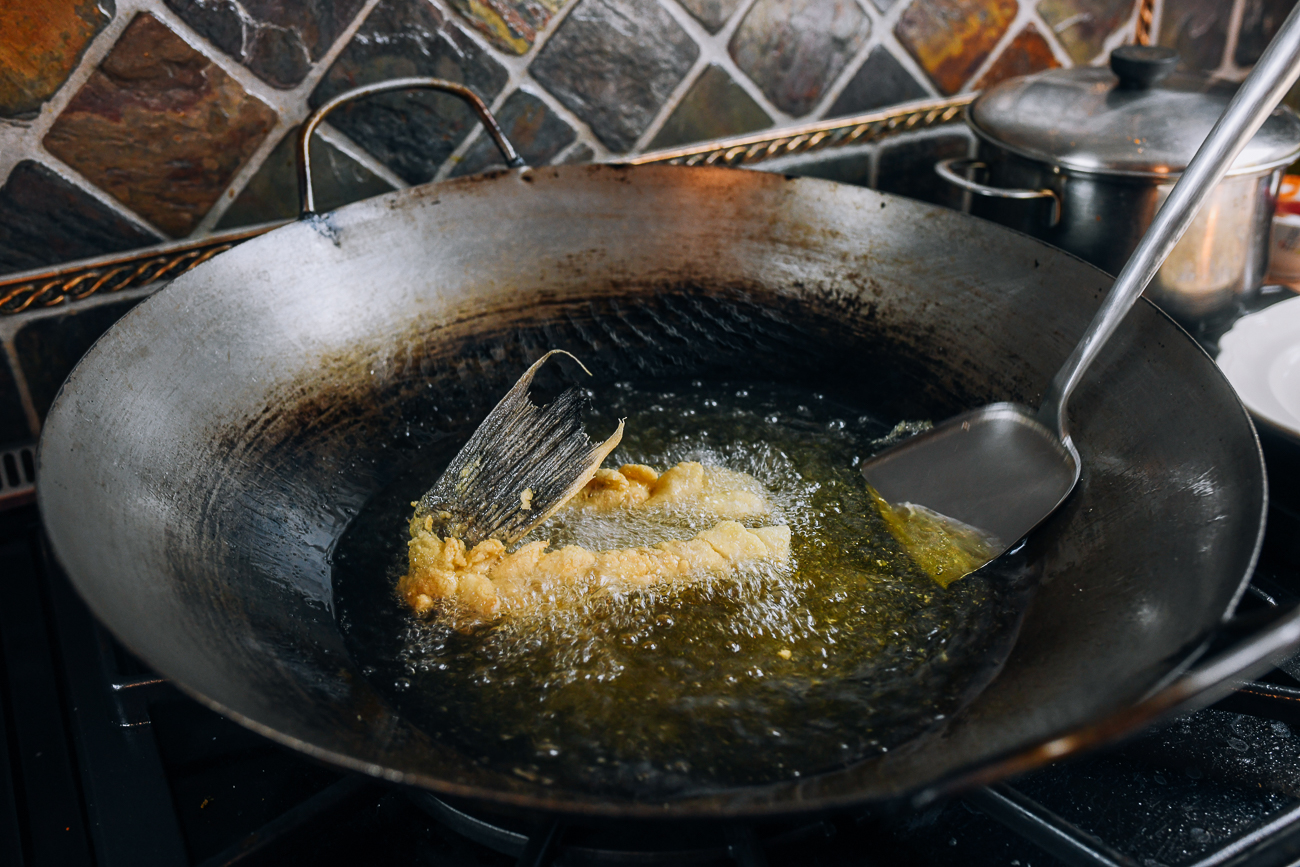
After 5 minutes, use a wide spatula to carefully lift the fish out of the oil (it’s a good time to grab a kitchen assistant!), and transfer it to an oblong serving plate.
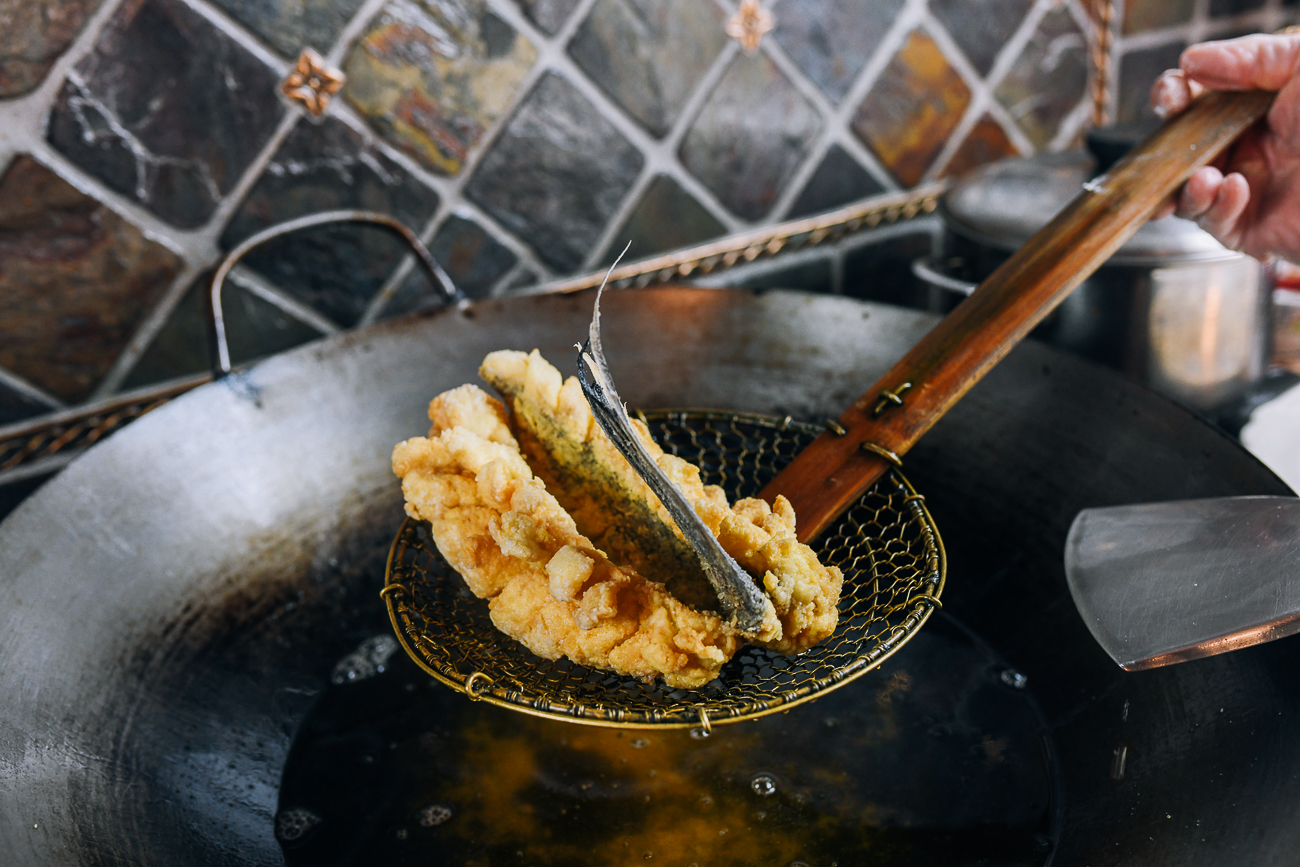
Next, fry the fish head until golden brown. Lay the fish into the oil so is flat, and not on its side.
Again, ladle the oil over any exposed areas, and keep the oil temperature around 350°F/175°C.
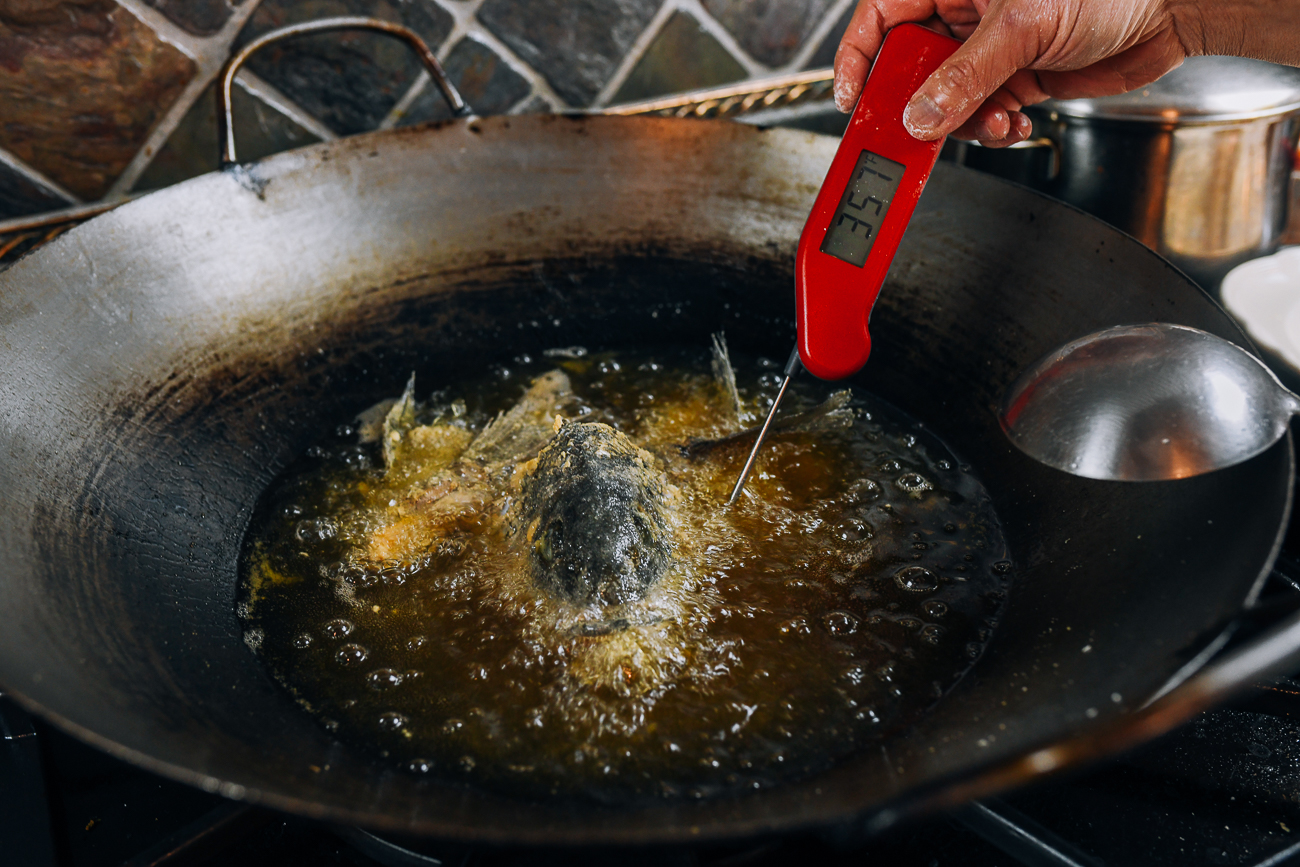
After 4 to 5 minutes, the fish head should be a light golden brown. Lift the fish head out of the oil using a strainer/spider and spatula, and let any excess oil drain off. Place the fried fish head at the front of the fish, with the pelvic fins flanking the head on either side. Remove the toothpick if you used one.
Finish the dish:
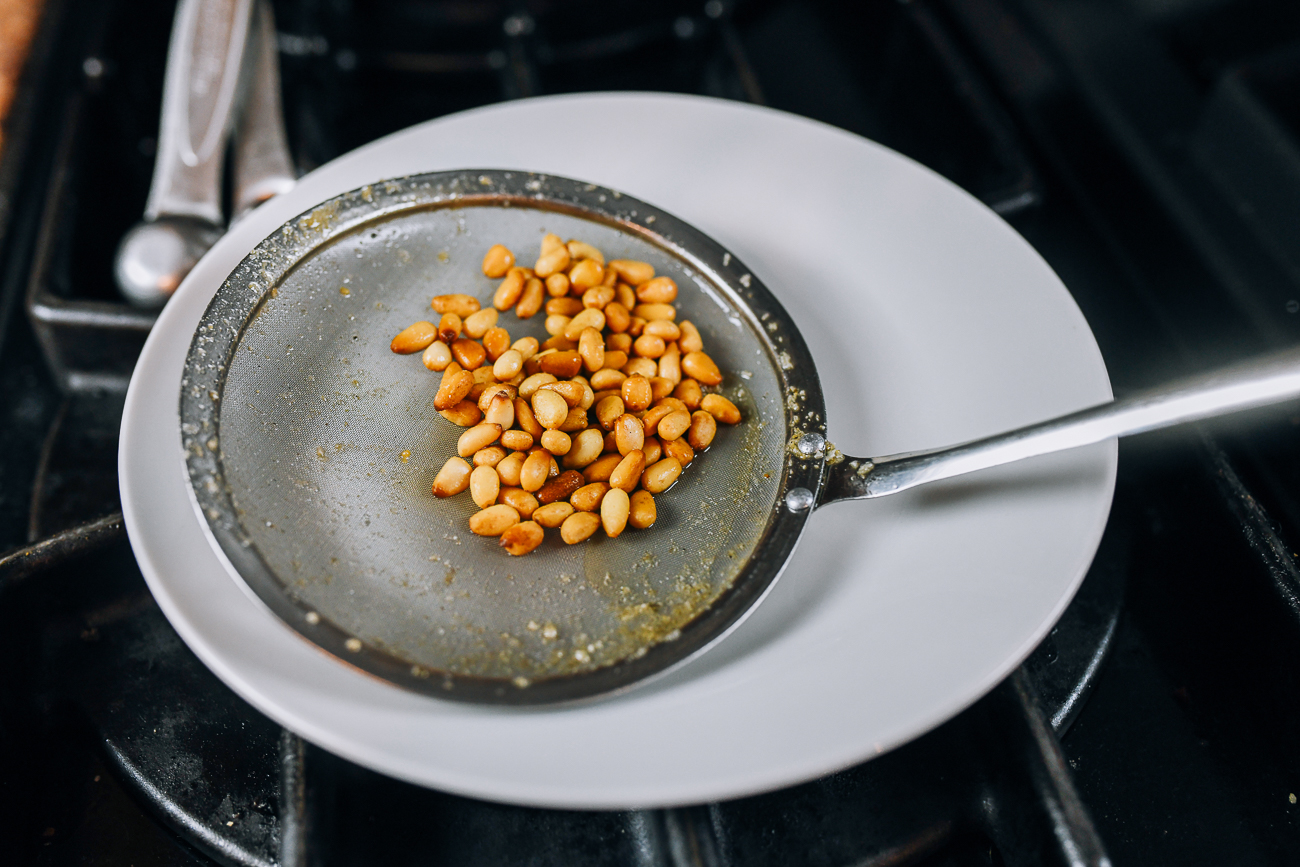
Place the pine nuts into a fine-mesh strainer and lower them into the oil. Fry for 30 seconds Transfer to a plate lined with a paper towel to drain.
Carefully transfer the hot oil to a different pot using a clean, dry ladle. Leave 2½ tablespoons in the wok.
Prep the peas. Blanch in boiling water until hot, for about 15-30 seconds. You can also microwave them for 1-2 minutes until hot, but still bright green. Drain and set aside.
Heat a wok over medium heat. To the 2½ tablespoons of the frying oil remaining in the wok, add the onion. Stir-fry for 30 seconds, until fragrant but not browned.
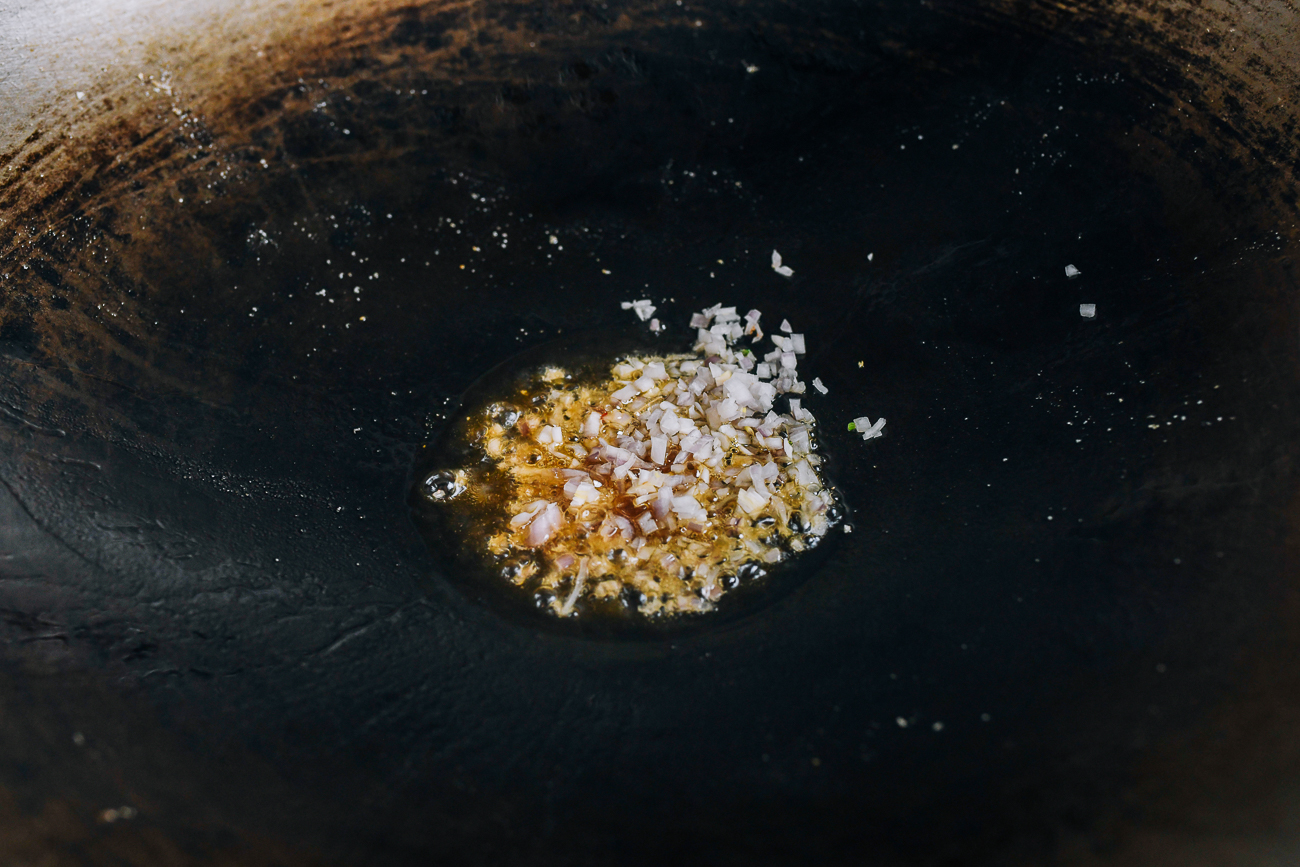
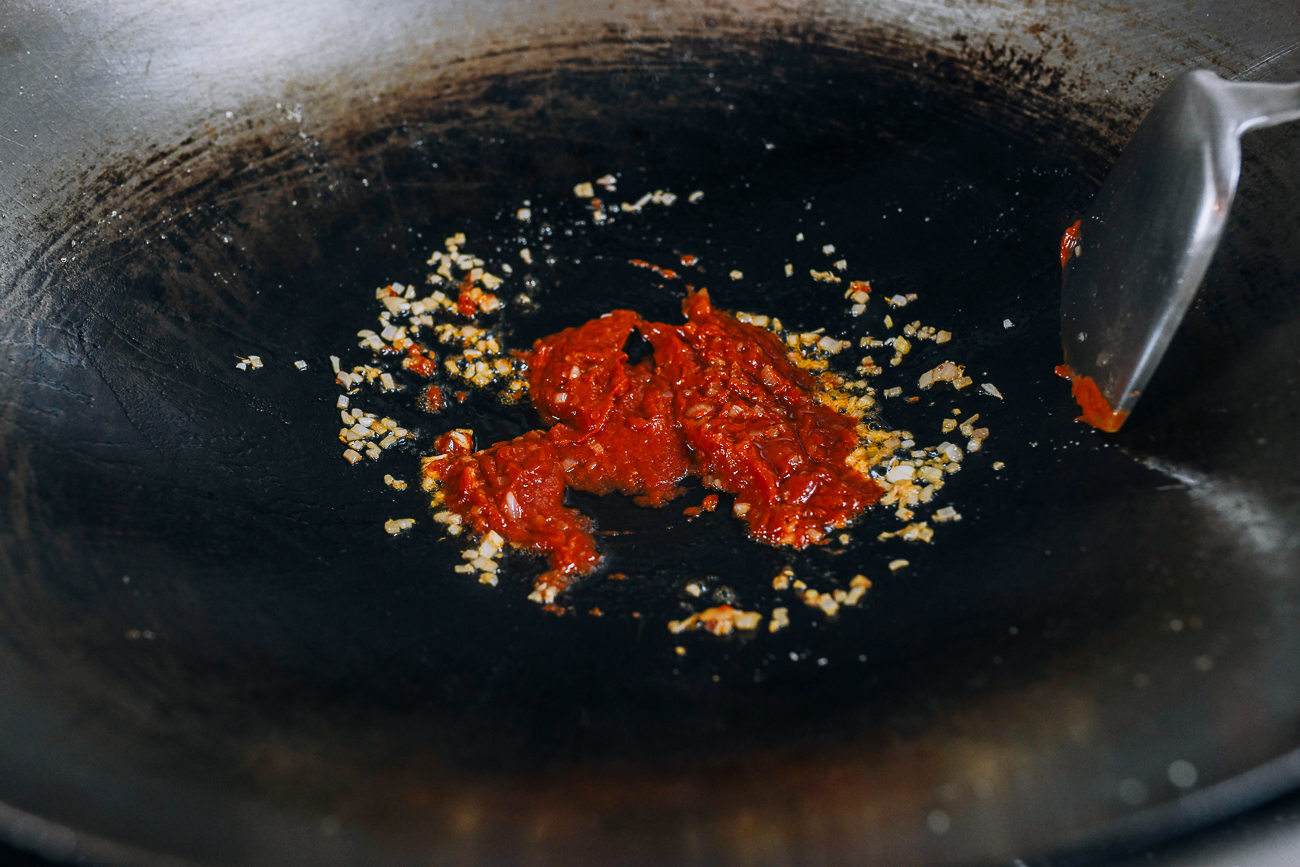
Add the tomato paste and ketchup mixture, and stir constantly for 30 seconds to cook.
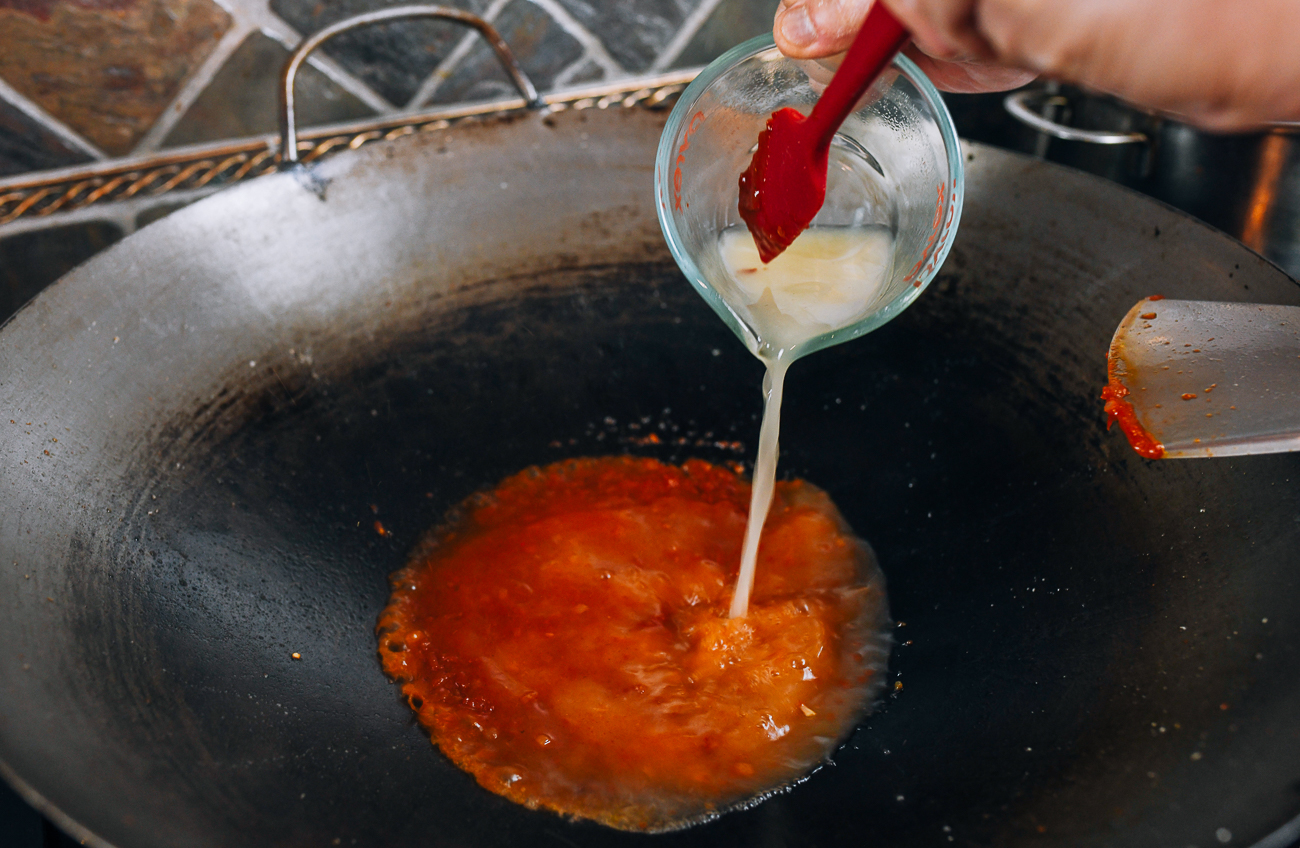
Give the water and vinegar mixture a good stir and add it to the wok.
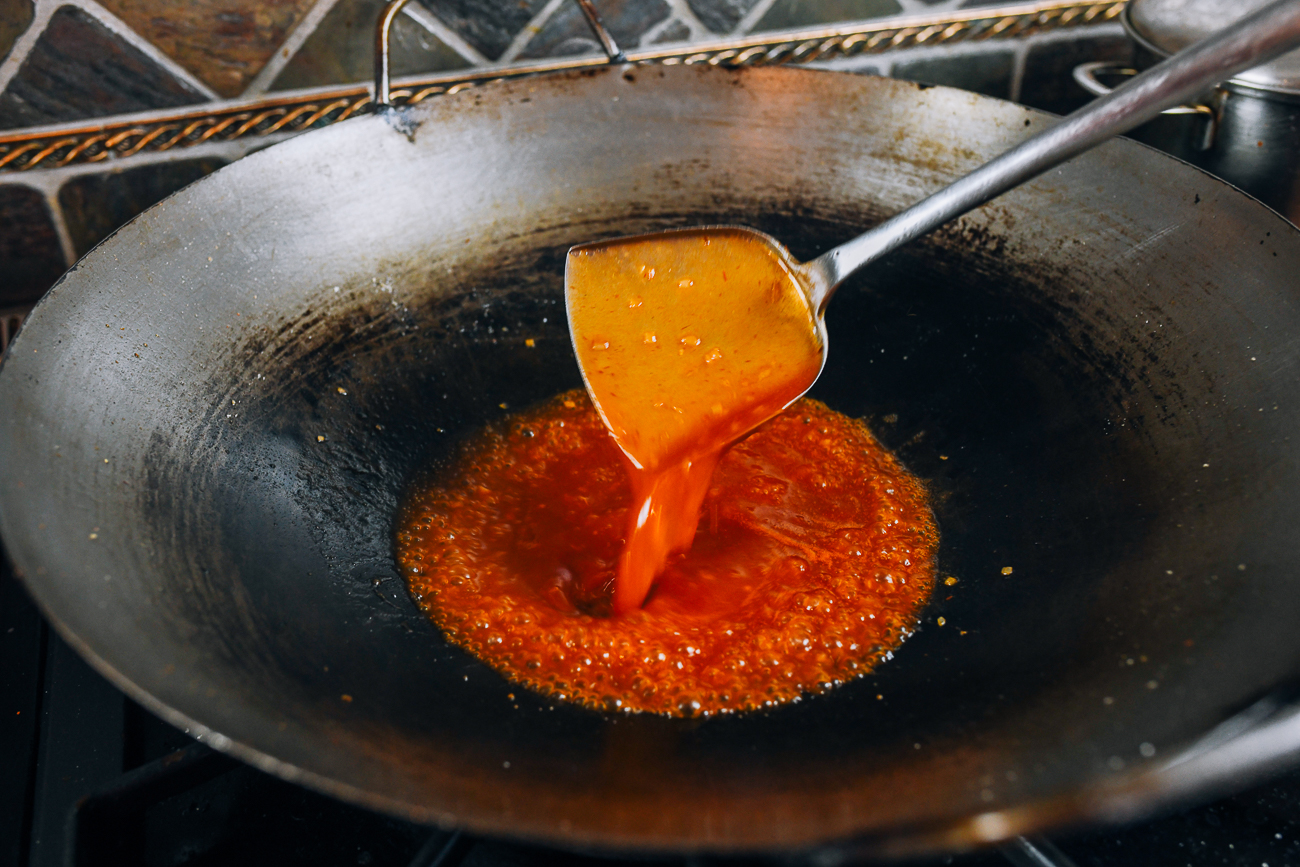
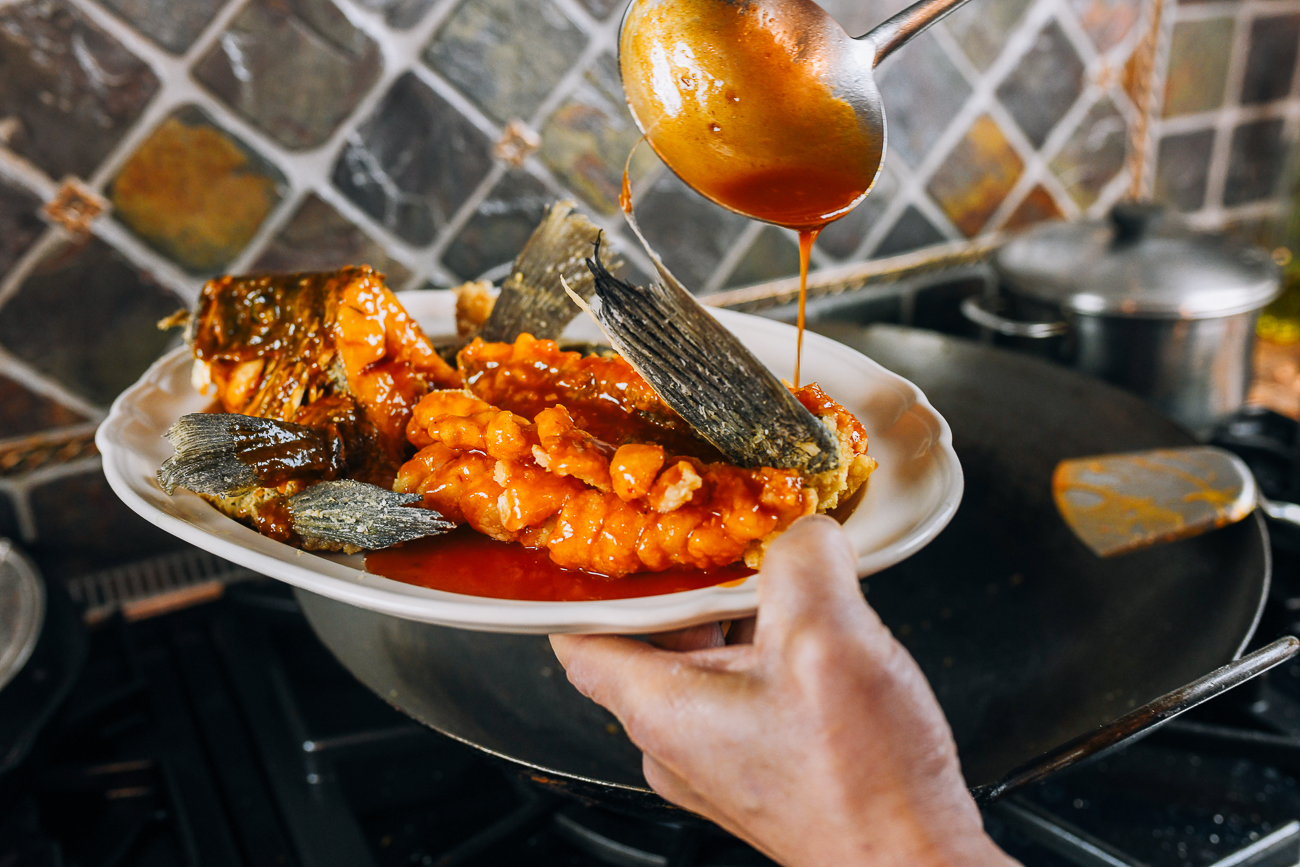
Bring to a simmer until the sauce is just thick enough to coat a spoon. It should be thin enough to pool around the fish and spread evenly when it is poured over.
Spoon the sauce over the fish, sprinkle the peas and pine nuts over the top, and serve!
Watch the Full Video (Process from Start to Finish)

Looking for more authentic recipes? Subscribe to our email list and be sure to follow us on Pinterest, Facebook, Instagram, and Youtube!
Recipe

Squirrel Fish
Ingredients
For the vinegar mixture:
- 3 tablespoons sugar
- 1/2 cup hot water
- 1 1/2 teaspoons cornstarch
- 6 tablespoons white vinegar
- 3 tablespoons pineapple juice
- 3/4 teaspoon salt
- 1/8 teaspoon white pepper
For the tomato mixture:
- 1 tablespoon ketchup
- 2 1/2 tablespoons tomato paste
- 1 1/2 tablespoons water
For the fish:
- 1 whole freshwater bass, sea bass, or branzino (about 1 1/2 to 2 pounds/680-900g; scaled, cleaned, and gutted)
- 1/4 teaspoon salt
- 1/8 teaspoon white pepper
- 2 teaspoons clear rice wine
- 1/4 teaspoon sesame oil
- 1 egg yolk
- 2/3 cup cornstarch
- 6 cups peanut oil or canola oil for frying
- 1 tablespoon pine nuts
- 1 tablespoon frozen peas
- 2 tablespoons onion (finely chopped)
Instructions
Make the sauce mixtures:
- Make the vinegar mixture: In a medium bowl, dissolve the sugar in ½ cup of hot water, and mix in the cornstarch, white vinegar, pineapple juice, salt, and white pepper.
- Make the tomato mixture: In a separate small bowl, mix the ketchup, tomato paste, and 1½ tablespoons hot water until smooth.
Fillet the fish and make crosshatch pattern:
- First, place your knife diagonally across the fish, just behind the head, collar and pectoral fins. Slice into the fish until you reach the backbone. Turn the fish so the belly is towards you. Place your knife at the head end, just above the backbone. Angle your knife blade slightly up (away from the backbone), and run the knife along it, pulling the meat up as you cut between the fillet and the bone. Then with your knife perpendicular to the fish, finish slicing the fillet from head to tail, using the backbone as a guide and stopping about 1-inch short of the tail. Flip the fish over and do the same on the other side.
- Next, cut the spine of the fish at the base of the tail. This will separate the tail and the two attached fillets from the rest of the fish.
- Using the heel of your knife, make a cut through the backbone just behind the head and the collar. The head should be able to sit on a flat surface with the mouth pointed up at an angle and each side of the pelvic fin portion of the fish flared to each side, supporting the head. The meat on the pelvic fin area can be a delicacy or fishy depending on the fish, so this is primarily for presentation. You may need to use your cleaver to flatten it slightly, so it sits at the correct angle. Set aside.
- Back to the fillets. With your knife at a slight angle, carefully score the fillets lengthwise—deep enough to reach the skin beneath without actually cutting through the skin. (Slicing the fish at an angle makes each segment longer with more surface area, and also helps prevent the knife from cutting through the skin.)
- Space the cuts ½ inch apart (you should be able to make 3-4 cuts easily, depending on how fat your fish is). Next, score the fish crosswise (again, at an angle), cutting down and away from the tail. Once again, make the cuts deep enough to reach the skin without cutting through it. This will create a crosshatch pattern. Each fillet segment should be roughly a ½-inch square.
- Dip the fish into an ice bath to rinse off any debris from processing and to tighten up the meat. Pat thoroughly dry with a paper towel. You should have two pieces: the head with the pectoral fin pieces attached and one large tail piece with the two cross-hatched fillets attached to it.
Dredge the fish:
- In a large bowl, combine the salt, white pepper, clear rice wine, sesame oil, and egg yolk. Coat the fish–the head and the fillets with the tail–in the mixture, ensuring all the nooks and crannies are covered.
- Pour the cornstarch onto a small sheet pan and dust the fish with it, thoroughly coating all of the nooks and crannies and shaking off any excess. You may have to repeat the process for full coverage. If desired, you can wedge a half a toothpick between the top and bottom of the fish mouth so it stays open during the frying process.
Fry:
- Heat 6 cups of oil in a wok to 425°F.
- Now you’re ready to fry the big piece of fish with the fillets. First, use one hand to grab the fish by the tail. With your other hand, use a pair of tongs to grab the opposite end, clamping the two fillets together by the skin so the skin is facing up, and the cross-hatched pieces curl and flare outward. Lower the fish into the oil carefully for 10-15 seconds to set the shape, keeping both ends of the fish out of the oil. This not only allows you to hold onto either end safely, it gives the fish a slight curled shape. (If preferred, you may use 2 pairs of tongs, though it may be harder to maintain a good grip on both ends of the fish.)
- When the cornstarch coating is fried to the point that the two fillets are grafted together, release the fish gently into the oil, and let it fry for 5 minutes. The temperature will have lowered when the fish was added to the oil—keep it at 350°F/175°C. The fish should keep its shape (the fillets shouldn’t float apart in the oil). Do not move or flip the fish. Just use a wok spatula or ladle to carefully spoon the hot oil over the top of the fish for even frying. After 5 minutes, use a wide spatula to carefully lift the fish out of the oil (it’s a good time to grab a kitchen assistant!), and transfer it to an oblong serving plate.
- Next, fry the fish head until golden brown, again ladling the oil over any exposed areas. After 4 to 5 minutes, when the fish head is a light golden brown, lift the fish head out of the oil using a strainer/spider and spatula, and let any excess oil drain off. Place the fried fish head at the front of the fish, with the pelvic fins flanking the head on either side. Remove the toothpick if you used one.
Finish the dish:
- Place the pine nuts into a fine-mesh strainer and lower them into the oil. Fry for 30 seconds Transfer to a plate lined with a paper towel to drain. Carefully transfer the hot oil to a different pot (you can use a clean, dry ladle to do this), and leave about 2 ½ tablespoons in the wok.
- Prep the peas. Blanch in boiling water until hot, for about 15-30 seconds. You can also microwave them for 1-2 minutes until hot, but still bright green. Drain and set aside.
- Heat a wok over medium heat. To the 2½ tablespoons of the frying oil remaining in the wok, add the onion, and stir-fry for 30 seconds, until fragrant but not browned. Add the tomato paste and ketchup mixture, and stir constantly for 30 seconds to cook. Give the water and vinegar mixture a good stir and add it to the wok. Bring to a simmer until the sauce is just thick enough to coat a spoon. It should be thin enough to pool around the fish and be absorbed into the fish when it is poured over.
- Spoon the sauce over the fish, sprinkle the peas and pine nuts over the top, and serve!