Velveting is a critical Chinese cooking technique. Meat or seafood is marinated and pre-cooked in oil or sometimes poached in boiling water. Then, the cook adds it to a stir-fry with other ingredients. In this post, we will teach you how to velvet chicken to yield the most tender and flavorful results for your favorite stir-fries.
Looking to make beef, pork, or shrimp instead? Check out our detailed posts on:
Why Velvet Chicken?
Velveting is an essential step when preparing chicken breast (or even dark meat) for stir-frying.
Have you ever tried stir-frying chicken, only to have it appear (and taste) dry in the finished dish? Have you ever wondered how Chinese restaurants get their chicken to be so tender and moist-looking?
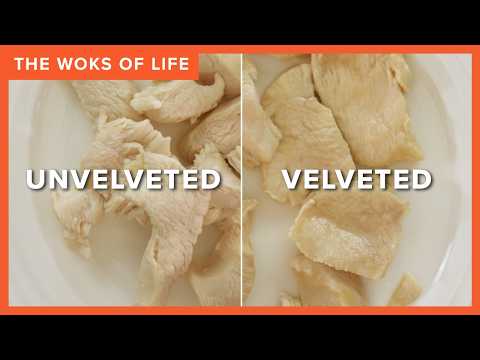
Velveting is the secret! It gives the chicken that silky texture, with retained moisture and flavor from the marinade. It also protects the chicken from the hot wok, yielding juicy chicken.

How to Slice Chicken for Stir-fries
Do you sometimes feel challenged when slicing chicken thinly to make a stir-fry? Trying to slice chicken uniformly when it is soft and slippery can be difficult even with a sharp knife!
I learned the answer the first time I worked in a Chinese restaurant kitchen as a prep guy. I cleaned and sliced vegetables, peeled shrimp, made egg rolls, and yes, I sliced up many chicken breasts!
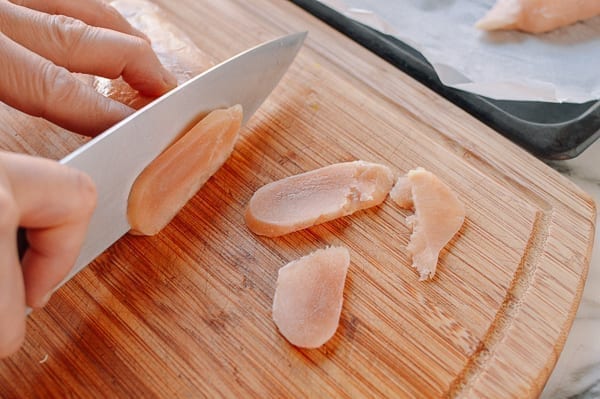
Before slicing them, I put them into the walk-in freezer until they were partially frozen––firm but not solid.
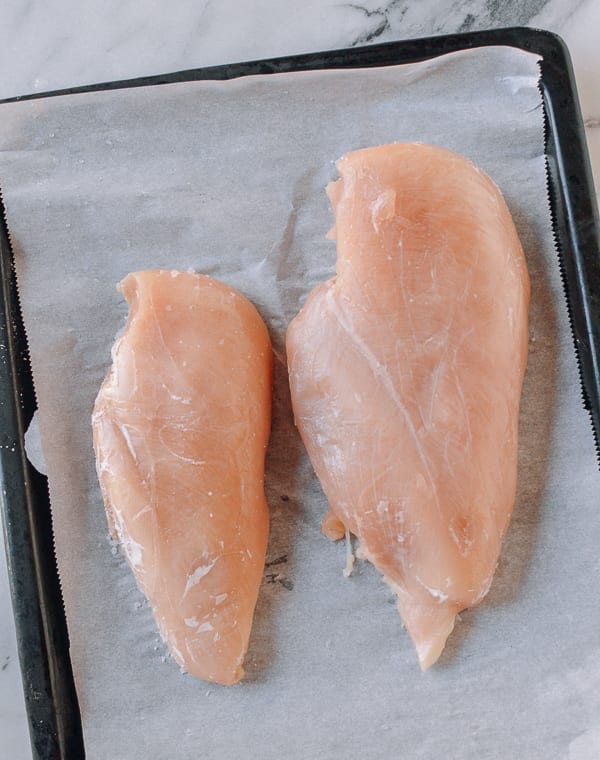
Once they are firm, they are very easy to slice into uniform, perfect slices. How’s that for a chef’s trick?
The chicken does have a “grain” which is the direction of the muscle fibers. It’s less obvious than in a piece of beef or pork, but it is there! It is generally best to cut across the grain for the most tender meat, similar to slicing beef. Something to keep in mind!
The Marinade
All restaurants (and most home cooks) velvet their chicken before making stir-fries, fried rice, etc. but they don’t all use the same method.
Baking Soda?
Some restaurants use baking soda as part of their marinade (you can tell by the crunchy or snappy texture of their chicken). In most cases, good quality chicken is already tender, which is why we don’t recommend adding any baking soda.
On rare occasions, you may get a tough chicken breast––a condition called “woody breast,” caused by hardened muscle fibers. Nobody really knows what causes it, but if you’ve ever had a stringy or tough chicken breast, you may have experienced it. That said, if your chicken is a bit more fibrous than usual, take extra care to cut across the grain.
Egg White?
We’ve seen that other sources on the Internet suggest adding egg white to velveting marinades. This is unnecessary.
Your return on that investment just isn’t worth the trouble. In my experience, most Chinese cooks do not do this.
So What Do We Recommend?
To marinate chicken for stir fries, we use a simple mixture of water, oil, cornstarch, and a flavor agent like soy sauce or oyster sauce. Other ingredients, like Shaoxing wine or sesame oil, may also be layered in.
So What Is Oil Velveting?
Oil velveting is a common practice Chinese restaurants use as a first cooking step. The equivalent Chinese phrase, zǒu yóu (走油) in Mandarin or jau yau in Cantonese, means “passing through oil.” It essentially refers to deep-frying.
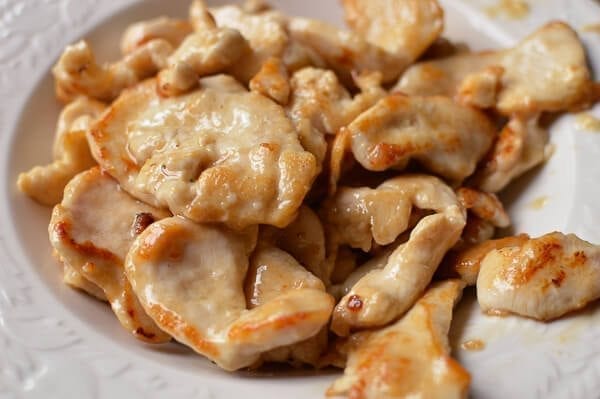
We recommend searing the chicken in a hot wok, as opposed to deep-frying. Not only is it easier, searing really brings out the chicken flavor and creates an ever-so-light crust. This crust eventually melts when your chicken is added back into your sauce, creating extra flavor. The result is a silky mouthfeel and a flavor bomb in each bite!
Can I Blanch the Chicken Instead?
For those of you who want to reduce fat in your diet or simply want that delicate taste of Cantonese cooking, you can blanch your chicken in boiling water.
When blanching chicken, you may want to add a pinch of salt or more soy sauce or oyster sauce to the marinade, since some of that seasoning will be washed away while cooking.
Watch: Bill shares everything you need to know!
How to Velvet Chicken: Instructions
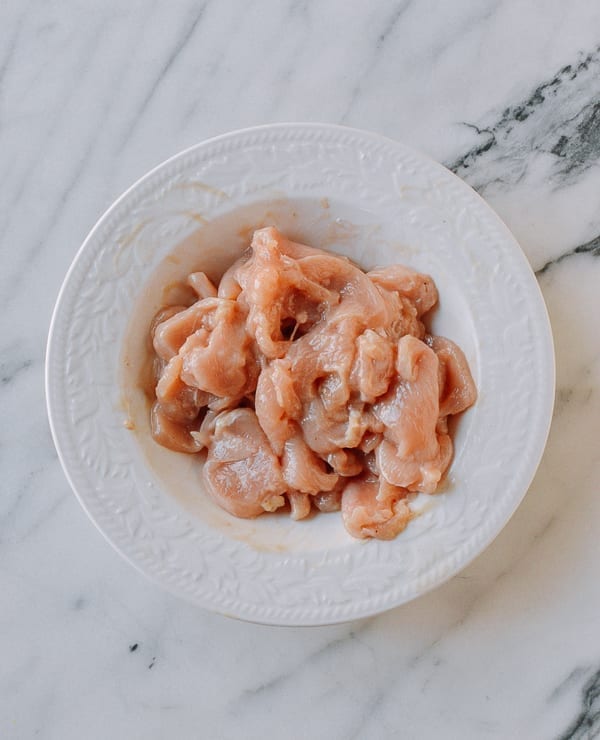
First, slice your chicken into 1½- to 2-inch (5cm) pieces, about ¼-inch thick. Remember to slice across the grain, especially if using chicken breast. The chicken breast in this photo was partially frozen for easy slicing.
Add the water and soy sauce (or oyster sauce) to the chicken in a medium bowl, and mix until the chicken is well-coated.
We recommend adding 2-3 tablespoons (30-45 ml) of water for 12-16 ounces (340-450g) chicken, but if your chicken is already moist because you rinsed it in water or maybe it was frozen with liquid, you can reduce the amount of added water.
After the water is massaged into the chicken, it should be absorbed within 10 minutes with no visible standing liquid.
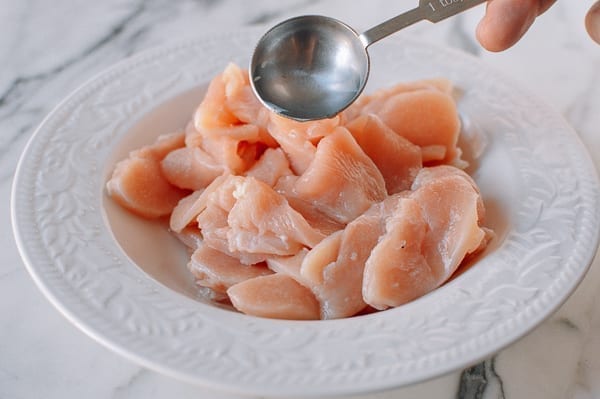
The small amount of water moisturizes the chicken. Adding water also helps the soy sauce or oyster sauce to further tenderize, penetrate and add an extra layer of flavor to the chicken.
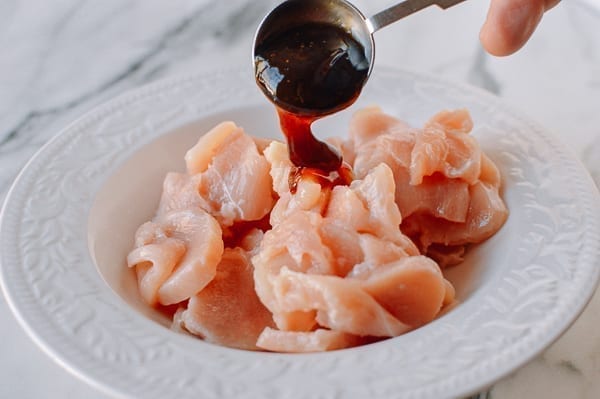
Set aside for 5-10 minutes. In that time, most of the liquid will be absorbed into the chicken.
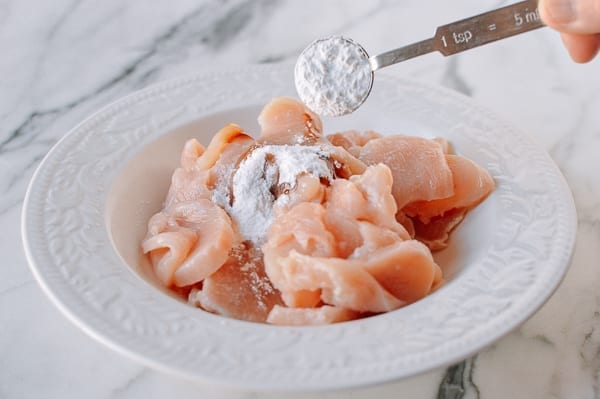
Add the cornstarch and vegetable oil and mix again until everything’s incorporated and the chicken is uniformly coated. For the best results, let the chicken sit for 15 to 20 minutes to marinate.
You could also let it sit overnight if you want to prepare your chicken in advance!
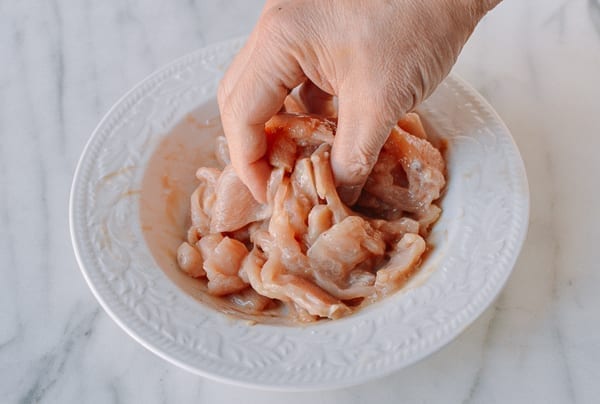
To sear, place your wok over high heat. When it starts to smoke lightly, add a couple tablespoons of vegetable oil to coat the surface of the wok. Add the chicken in one layer, and allow to sear for 20 seconds.
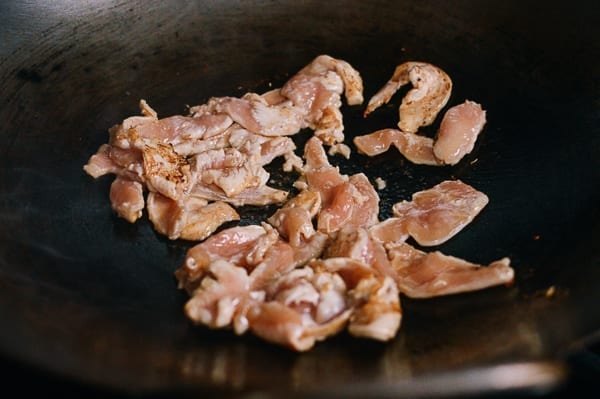
Stir-fry until the chicken has turned opaque, and remove from the wok.
If you would rather blanch your chicken, add the chicken to a wok filled with boiling water. When it turns opaque, cook for an additional 10 seconds (the chicken will be cooked 80% through). Then, remove from the wok.
Remember, in both scenarios, you will be cooking the chicken again in your stir-fry, so avoid overcooking it during the pre-cook process!
Use This Velveting Technique in these Chicken Recipes:
- Chicken with Black Bean Sauce
- Kung Pao Chicken
- Chicken and Broccoli with Brown Sauce
- Cashew Chicken
- Chicken and Chinese Broccoli Stir Fry
- Moo Goo Gai Pan: Mushroom and Chicken Stir Fry
- Bourbon Chicken
- Spicy Chicken Stir-fry (Firebird Chicken)
Looking for more authentic recipes? Subscribe to our email list and be sure to follow us on Pinterest, Facebook, Instagram, and Youtube!
Recipe

How to Velvet Chicken for Stir-Fry
Ingredients
- 12-16 ounces boneless skinless chicken breast (or thighs, 340-450g)
- 2-3 tablespoons water (30-45ml)
- 2 teaspoons soy sauce (or oyster sauce)
- 2 teaspoons cornstarch
- 2 teaspoons vegetable oil
Instructions
- First, slice your chicken into 1 ½ to 2 inch pieces, about ¼ inch thick. Remember to slice across the grain, especially if using chicken breast.
- Add the water and soy sauce (or oyster sauce) to the chicken in a medium bowl, and mix until the chicken is well-coated. Set aside for 5-10 minutes. In that time, most of the liquid will be absorbed into the chicken.
- Add the cornstarch and vegetable oil and mix again until everything’s incorporated and the chicken is uniformly coated. For the best results, let the chicken sit for 15 to 20 minutes to marinate.
- To sear, place your wok over high heat. When it starts to smoke lightly, add a couple tablespoons of vegetable oil to coat the surface of the wok. Add the chicken in one layer, and allow to sear for 20 seconds. Stir-fry until the chicken has turned opaque, and remove from the wok.
- To blanch, add the chicken to a wok filled with boiling water. When it turns opaque, cook for an additional 10 seconds (the chicken will be cooked 80% through). Then, remove from the wok.
- Remember, in both scenarios, you will be cooking the chicken again in your stir-fry, so avoid overcooking it during the pre-cook process!